Teaching our Children: Why did people want to kill Jesus?

We’ve been careful to teach our kids that Jesus loves each and every one of us, but then when Lent comes, how do we go on to explain why so many people wanted him dead?

Anglican Virtual Church School lesson writer, Fiona Brownlee challenges us to tell our children the whole truth about Jesus:

“I think we need to be honest with our children. I think we need to give them the whole story of Jesus. Not just the parts that make us comfortable.

Jesus during his ministry made many people uncomfortable. He made the religious leadership uncomfortable. He made the political leaders uncomfortable. I think if he visited one of our parishes he would make us uncomfortable as well.

Children need to know that Jesus made and continues to make people uncomfortable. For some in Jesus’ day this discomfort turned into fear and they thought the only way to deal with it was to put him to death.”

– Fiona Brownlee

Read the full article Lent, Children and Honesty about Jesus

Education Opportunity: Indigenous Wisdom

Indigenous Wisdom
with Bishop Mark MacDonald

University of Winnipeg
Faculty of Theology

April 30-May 4, 9 – 5 pm
North End Campus
527 Selkirk Avenue

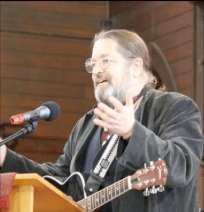
Bishop Mark MacDonald is National Indigenous Bishop of the Anglican Church of Canada. He is also a musician, a theologian, an educator and a healer.

Available for audit,
diploma or degree credit.
For more information please contact Chris Wells at the University of Winnipeg 786-9857.

The National Worship Conference: June 29 – July 2, 2012

What does it mean
to go Beyond the Fortress?

As Christians, we have established meaningful traditions in our worship. In doing so, we have built “fortresses” around ourselves, in order to keep these traditions alive. For some the fortress is their church, for some it is their faith. We carefully guard our fortresses (with open doors – not closed doors), but we all feel safe and secure in our personal Fortress.

What happens when we leave our security, and move out into the community and witness our faith?

But what happens when we go Beyond our fortress. What happens when we leave our security, and move out into the community and witness our faith? Do we hide or guard the fortress, to make sure that nothing will change and our traditions are kept strong. How can we make worship more interesting and inviting and draw more people in? This has always been a topic at the forefront of discussions in the Church. It’s now more urgent than ever.

Come join us at the Conference to discuss with fellow Worship Leaders how to be comfortable beyond the fortress, and explore what happens when we move out and profess our faith to all who will listen.

About The National Worship Conference

The National Worship Conference is a biennial conference sponsored by the Evangelical Lutheran Church in Canada and the Anglican Church of Canada. The Conference welcomes participation by clergy and laity of these two churches as well as clergy and laity from other churches who seek to build up the life of the Christian community through our worship so that we might serve the world God loves.

Find out more about the The National Worship Conference or register.

Action!

an article by Nancy Phillips
from the February 2012 edition of the Rupertsland News

If our spiritual practices are not grounded in the stuff of our everyday lives,
all of this thinking and praying becomes meaningless.

Over the past while, I’ve written much about contemplative practices, prayer, deepening our spirituality, connecting with God and seeing reality from a different perspective. But if these practices and new ways of experiencing God are not grounded in the stuff of our everyday lives, all of this thinking and praying becomes meaningless.

It has been said that human beings are the only creatures who have been created with the faculty of reflection.  We are able to raise our experience to consciousness.  Rocks and sand may also have experiences but no ability to reflect.  In reflecting on our experiences we begin to realize that we are not only created, but also creators.   In reflecting upon our experiences, we find our purpose.

Our purpose is rooted in our relationship to God. The work of spirituality is to rejoin the one.  God is one.

Our purpose is rooted in our relationship to God.  The work of spirituality is to rejoin the one.  God is one.  Thomas Merton, a modern contemplative, discovered in his reflections that people are inseparable from God and from one another.  In becoming aware of this unity in God with all peoples, Merton had a deep experience of nondualism.  He found that he could not separate God from God’s creation, but also could not separate contemplation from concern for, and engagement in, the needs and problems of the age in which he lived.  God became incarnate and this created a bridge between divine and earthly.

Mature religion, Rohr says, involves changing ourselves and letting ourselves be changed by a mysterious encounter with grace, mercy, and forgiveness.

Our ability to reflect allows us to become aware of our experience of life at the level of ordinary consciousness – a kind of “one thing at a time awareness”.  But our reflective ability also allows us to center ourselves in the midst of an unconscious awareness at both the personal level and the collective level.  Getting to know God begins with getting to know yourself.   Richard Rohr reminds us in his book, The Naked Now, that only transformed people have the power to transform others, as if by osmosis.  Usually, he says, you can lead others only as far as you yourself have gone.  Too often we try to push, intimidate, threaten, cajole, and manipulate others.  It seldom works, because that is not the way the soul works.  In the presence of whole people; or any encounter with Holiness Itself, we simply find that, after a while, we are different – and much better!   Mature religion, Rohr says, involves changing ourselves and letting ourselves be changed by a mysterious encounter with grace, mercy, and forgiveness.

Use your imagination to create the world God is calling us to live into.  And then move — breathe life into your images of hope and healing and wholeness.

God has given us a new consciousness in what we call “prayer” and an utterly unexpected, maybe even unwanted, explanation in what we call “the cross”.  Part of that new consciousness involves using our faculty of imagination as a first step in creating a better world.  We see imagination being used to span the reality between heaven and earth in the New Testament book of Revelation – in John’s description of images while on the Isle of Patmos.  Great artists create visual images using the faculty of imagination.  The visual images artists create are a bridge between their inner world of image and form and colour and the outer world of art medium – paint and clay.  The images they create are a bridge between inside and outside – materiality injected with spirit.  Images are messengers – angels perhaps – places we have forgotten about.

Use your imagination to create the world God is calling us to live into.  And then move — breathe life into your images of hope and healing and wholeness.

All of this reflecting about image and imagination, the tension between inner and outer is rooted and grounded in our relationship with Christ.  This relationship is described by William Barry as being analogous to the kind of friendship that develops over a long time between two people. They are aware of each other even when they are apart or not engaging directly with each other. Although they may not be talking, at some deep level they are in touch with each other. Ignatius’s idea of contemplative-in-action has such a relationship with God. Engaging closely with God over time, we allow the Spirit to transform us into people who are more like the images of God we are created to be—that is, more like Jesus, who was clearly a contemplative-in-action.

The first step in creating a better world is imagining a better world.  We must spend time on the bridge of our imagination and be open to the energy God is creating to move us to action.  Use your imagination to create the world God is calling us to live into.  And then move — breathe life into your images of hope and healing and wholeness.

We are made holy
by our recognition
of God in us.
God is in all and everything.
But the reality of
God’s presence
only comes about
through human recognition.
Ah then!
We have the power
to sacralize the world.  

By Edwina Gateley; There Was No Path So I Trod One (1996).

If you would like to find out more about contemplation and action, please join us tomorrow for Tools for Responding to God: Reaching Outthe last session in the series Growing towards God,  facilitated by Nancy Phillips.
Quiz: Praying by the Book

by Rene Jamieson

If you’re an Anglican, this quiz is right up your alley. Even if you’re not an Anglican, you’ll probably be surprised by how much you know about the Book of Common Prayer. I hope you will enjoy this quiz regardless of your denominational affiliation. 

Question 1:

In which year did the Book of Common Prayer first come into use?

  • 1560
  • 1549
  • 1534
  • 1558

Question 2:

 Who compiled the Book of Common Prayer?
  • Thomas Cranmer
  • Henry VIII
  • Edward VI
  • A committee of bishops of the Church of England

Question 3:

How many liturgies for worship are there in the Book of Common Prayer?

  • 21
  • 16
  • 10
  •   9

Question 4:

On which text is much of the Book of Common Prayer based?

  • The Durham Prayer Book
  • The King James Bible
  • None of these
  • The Sarum Primer

Question 5:

When it was first introduced, was the Book of Common Prayer universally accepted throughout England?

  • Yes
  • No

Question 6:

Is it true that the Book of Common Prayer has never been revised since its introduction?

  • Yes
  • No

Question 7:

The original Book of Common Prayer required the writing of a new liturgy for use in the Church of England. Which one was it?

  • The Wedding Ceremony
  • Holy Communion
  • Compline
  • Morning Prayer

Question 8:

Has the Book of Common Prayer has been influential in the development of liturgies in other Christian denominations?

  • Yes
  • No

Question 9:

Do Anglicans throughout the world use the same Book of Common Prayer?

  • Yes
  • No

Question 10:

Are the readings and the psalms for use in worship found in the Book of Common Prayer taken from the King James Version of the Bible?

  • Yes
  • No

The answers will be provided when the third quiz in the series goes on line. 

Becoming Whole Again

from the January, 2012 Rupertsland News article by Nancy Phillips

So here we are at the beginning of another calendar year.  We face that time of the winter when the long, cold darkness spreads out before us without even a hint that Spring will show its face again one day.  This new beginning provides us with an opportunity to reflect and re-think the way we engage with life.  Our New Year’s resolutions may involve a re-directing of our intentions in prayer or spiritual development.

The beginning of a new year provides a good opportunity to reflect on the different ways we engage with our inner selves.  We may have fed our souls by trying some new styles of prayer, fed our minds by trying a different way of studying scripture, such as lectio divina, or tapped into a new way of uncovering our inner spaces through techniques such as journaling.  But we may not have thought of our bodies as an important source of information which may assist in our transformation.

To be a “whole” person, we need to be “healed” in all dimensions of our being – body, mind, heart and spirit.

Our bodies are an incredible storehouse of information about our past history and this information can either aid or hinder our inner growth.  The experience of psychological or physical trauma can deeply affect our ability to live freely as our authentic selves and result in our living a shame-based life.  Maureen Conroy, a Roman Catholic religious and Spiritual Director, explains that we are created in wholeness and for wholeness.  Our journey through life is to reconnect with our original wholeness, our authentic self, our child-like innocence. To be a “whole” person, we need to be “healed” in all dimensions of our being – body, mind, heart and spirit.  Every life issue and experience, positive and negative, Conroy teaches, lives in our body – our issues are in our tissues.  Our body is our closest companion in life – the part of ourselves that we may experience as being the most “real”.  Conroy says our bodies – our tissues, fluids, cells, nervous system and brain – absorb emotional, psychological and physical trauma and pain that is too overwhelming for our psyche to carry on its own.

Suffering can make us bitter and close us down or it can make us wise, compassionate and utterly open.

Richard Rohr, in his book, The Naked Now says that the two universal and prime paths of transformation , great love and great suffering, are the primary spiritual teachers.  Great suffering occurs when things happen against our will.  Over time we can learn to give up our defended state, although, Rohr says, we will inevitably go through the stages of denial, anger, bargaining, resignation and (hopefully) on to acceptance.   Rohr explains that our suffering might feel wrong, terminal, absurd, unjust, impossible, physically painful, or just outside of our comfort zone.  But if we don’t have a proper attitude toward suffering, we can’t transform our pain.  If we don’t transform our pain, we can transmit it to those around us and even to the next generation.  Suffering can make us bitter and close us down or it can make us wise, compassionate and utterly open. Rohr says we should pray for the grace of this path of softening and opening to God.  Our experiences of struggling with our shadow self, facing interior conflicts and moral failures, undergoing rejection and abandonment, daily humiliations, experiencing abuse or any form of limitation are all gateways into deeper consciousness and the flowering of the soul.

The long cold days of winter invite us to look inward.  You may want to spend some time focussed on prayer that engages with your body.  The following exercise may be helpful in bringing about awareness of your body and areas that may be in need of God’s healing grace.

As you pray, experience healing from God that brings freedom from suffering and leaves you feeling empowered and healthy.

  • Enter into a quiet space and become aware of your breath – exhale fears and anxieties and inhale God’s loving spirit
  • Be aware of sensations in your body by slowly scanning various parts of your body from your skull to your feet.  Allow your awareness and your breath to soften tight muscles and anxious thoughts.
  • See yourself in your truest and deepest essence – whole, free, joyful, living life to the fullest.  Savour and experience yourself in your divine essence, your wholeness
  • Visualize yourself at a certain period in your life.  Invite God’s healing light to flow gently into that period of your life, healing traumatic experiences, any form of abuse, emotional neglect, painful encounters with another and so on.
  • Place one of your palms on your abdomen and the other on your chest.  Feel yourself grounded in your body.  Intend for God’s healing light to flow into your body, your mind, your heart and your spirit.
  • Be aware of and feel divine healing energy flowing into painful feelings and attitudes toward yourself that may have developed such as shame, self-hatred or low self-esteem
  • Place your healing hands on other parts of your body and being as you feel drawn to do so, allowing God’s love and light to flow.
  • Visualize Jesus and/or the Holy Spirit, surrounding you with love and light.  Feel God’s unconditional love seeping into your core.

You may wish to enter into this prayer experience for inner healing daily for several consecutive days or on a weekly basis for several months.  As you pray, experience healing from God that brings freedom from suffering and leaves you feeling empowered and healthy.  May God’s love surround you always.

Nancy Phillips 

Interested in learning more? Please join us tomorrow night for Tools for Responding to God’s Presence: Reaching In, session 4 of the Growing towards God series, Introduction to Spirituality. We will explore the differences between guilt and shame and introduce the Welcoming Prayer as a tool for deepening our awareness of God’s presence dwelling within us. An opportunity will be provided to engage with Body Prayer as a tool for healing.

Responding to God’s Presence: Reaching In

The Fourth Session in the St. John’s Educational Series Growing towards God
with Nancy Phillips, Facilitator
Tuesday, January 10th from 6 pm to 8 pm
Brown Bag Supper at 5:30 pm (optional)

Growing Towards God: January 10

Tools for Responding to God’s Presence:  Reaching In

Growing towards God: Session 4
Tuesday, January 10 at 6 pm to 8 pm
Brown Bag Supper at 5:30 pm (optional)

Spirituality is about moving beyond ordinary awareness so that we can live our lives in a state of constantly awakening to God’s goodness and presence within us.

On Tuesday night, we will explore the differences between guilt and shame and introduce the Welcoming Prayer as a tool for deepening our awareness of God’s presence dwelling within us.  An opportunity will be provided to engage with Body Prayer as a tool for healing.

Please join us.

Announcing: Monthly Quiz

Since Anglicans in general are of a particularly questioning mode (and, thank God, are encouraged by the Church to be so), we’re instituting a monthly quiz, put together by our beloved Rene Jamieson. The first effort is about Handel’s ‘Messiah’, which is most appropriate to the season. Future quizzes will focus on the Book of Common Prayer, the life and work of Thomas Cranmer, English translations of the Bible, and eccliastical trivia of one kind or another. Enjoy!