
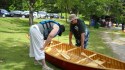
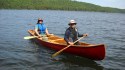

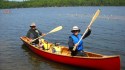
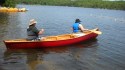


The beautiful cedar canoe in these pictures was a gift from the cathedral to the former Dean, Bob Osborne, to thank him for his ministry here. Members of our parish signed the underside of the canoe and wrote special messages of thanks and well-wishes before it received its final coats of paint.
Dean Bob writes:
Hi everyone,
Here are some pictures of the launch of the canoe last Saturday. It was a fun family event as you can see by the pictures. I am ever so pleased with how the canoe handles in the water. What a wonderful memory knowing that so many of St. John’s people are riding with us on the underside of the cedar planks. It is a gift I will enjoy for many years.
Bob
The Cathedral’s Greatest Treasure
by Rene Jamieson
Why is a wooden plaque and its cross made of 800 year old nails the Cathedral’s greatest treasure?
On May 26th and 27th, the annual Doors Open Winnipeg brought several visitors to St. John’s. Doors Open is an opportunity for Winnipeggers to explore buildings around the city, buildings that aren’t usually open to the public or that people wouldn’t visit otherwise. The majority of Doors Open visitors to St. John’s aren’t Anglicans and would not come through our doors to worship with us, but they all agree that St. John’s Cathedral is one of the best kept secrets in Winnipeg.
The visitors marvel at the beauty of our stained glass windows, and the stateliness of the cathedral interior. They are intrigued by the intricately carved pulpit and fascinated by Big Bird, our lectern. On the cemetery part of the tour, they enjoy learning about some of the interesting people who occupy the graves that surround our doors, and they are entertained by our stories of the history of St. John’s, its role in the growth of our city and province, and the people who made that growth possible.
One of the last things that I tell the tourists about is the piece that I consider to be the greatest treasure of the Cathedral, and yet so many of us in the congregation don’t even know that it’s there! It’s the Coventry Cross of Nails on a simple wooden plaque, and its is mounted on the wall beneath the Anglican Communion window in the south transept. When I tell the story behind that plaque, many of our visitors are moved to tears (and so am I!).
On November 14th, 1940, the city of Coventry in the West Midlands of England was the target of the Luftwaffe. One of the major casualties of that dreadful night was the 14th century Gothic cathedral of St. Michael.
On November 14th, 1940, the city of Coventry in the West Midlands of England was the target of the Luftwaffe. Wave after wave of bombers unloaded their deadly incendiary cargo on the industrial city, knocking out utilities, utterly destroying the city centre, wiping out 4,000 homes, killing hundreds of people, and injuring thousands more. One of the major casualties of that dreadful night was the 14th century Gothic cathedral of St. Michael. (There is no truth, by the way, to the story that’s been handed down about Winston Churchill “sacrificing” Coventry so that the Nazis wouldn’t find out that the Enigma code had been cracked. Churchill and his advisors believed that London was the target that night, and were totally unprepared for the devastation of Coventry.)
From the rubble of the devastated cathedral, work crews salvaged hundreds of nails used by the builders of the beautiful mediaeval building. They weren’t nails as we know them today, but solid spike-like iron pins, measuring between eight and ten inches. The nails were made into crosses, and after the war, dignitaries from Coventry Cathedral carried them on their travels around the world and gave them to cathedrals in dioceses they visited. Such a recipient of a Coventry Cross of Nails is St. John’s Cathedral.
teams came from Germany as volunteers to help to build the new cathedral. In the same spirit, teams of Britons went to Germany to help to rebuild churches that the Allies had destroyed.
The story doesn’t end there. The ruins of the mediaeval cathedral in Coventry still stand as a memorial, but alongside the ruin is the new Coventry Cathedral. Designed by Sir Basil Spence, the modern Coventry Cathedral was begun in 1956. It took six years to build, and the Cathedral was consecrated in May, 1962. During the building period, teams of young men and women came from Germany as volunteers to help to build the new cathedral. In the same spirit, teams of young Britons went to Germany to help to rebuild churches that the Allies had destroyed in bombing raids.
For me, the Coventry Cross of Nails at St. John’s is a symbol of repentance, forgiveness, and reconciliation, echoing the words carved on the wall of the ruined sanctuary of the 14th century cathedral in Coventry. They read: “Father Forgive”, and that’s why I consider the wooden plaque and its cross made of 800 year old nails to be the Cathedral’s greatest treasure.
Five Marks of Mission
The Bare Bones of it
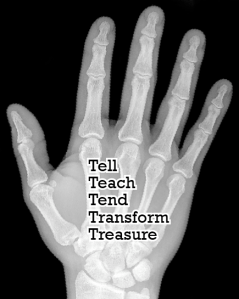
The Five Marks of Mission have won wide acceptance among Anglicans, and have given parishes and dioceses around the world a practical “checklist” for mission activities.
But can you recall each of the Five?
These shorter versions might help you remember them a little better!
Summary Version
The June edition of the Anglican Journal summarizes The Five Marks of Mission them like this:
- share the good news
- teach new believers
- help people in need
- work to make things fairer
- look after the planet
Easy-to-remember version: The 5 T’s
- Tell
- Teach
- Tend
- Transform
- Treasure
Want the real deal? Read them here, and see what our Bishop has to say about the Five Marks of Mission.
The Council of General Synod Updates
‘But you will receive power when the Holy Spirit has come upon you; and you will be my witnesses in Jerusalem, in all Judea and Samaria, and to the ends of the earth.’ Jesus to the apostles, Acts 1.8
Identifying the issues
The Council of General Synod (CoGS) met this past week to devote two full days to clearly understand the current issues facing the Anglican Church of Canada. This is what they came up with:
- a need for strong communications and stewardship education
- a need to better understand the Indigenous journey towards self-determination
- a desire for future church structures to be nimble and flexible
Opening passage, Acts 1 served to keep the end goal of action ever present in the minds of CoGS members. Another day in November will be spent charting action steps to address these issues.
Are we missing the point?
Are these really the issues we need to be focusing on? Archbishop Fred Hiltz, primate of the Anglican Church of Canada, said he wasn’t convinced that members were grasping the urgency of our situation.
“We need to address [the issue] of finances and structure,” said Hiltz. “Things must change if we’re going to go ahead in the spirit of the Marks of Mission.”
More on the CoGS:
Fresh ideas for church structure, finances, elude CoGS
Council of General Synod Highlights: May 24 and 25
COGS Highlights
Monica Irene Kew
Monica Kew
was a loving and beloved part
of the St. John’s Cathedral church family, and she will be sorely missed.
Monica Kew was a loving and beloved part of the St. John’s Cathedral church family, and she will be sorely missed. She especially loved singing in the choir, as she loved all beautiful music. She lived an amazing life, but now we entrust her to God’s loving mercy which sustained her all her days of her life. Rest eternal grant to her, O Lord, and let light perpetual shine upon her.
Below is her obituary as published in the Winnipeg Free Press on May 22, 2012.
The family mourn the passing of our sister, aunt and great-aunt, Monica Irene Kew. Born the oldest of the late Irene and Harry Kew’s children on July 21, 1932. Passed away in Winnipeg, Manitoba, on Thursday, May 17, 2012, at the age of 79. Monica was born and raised in Hong Kong, attended the private Anglican British Girls School (Diocesan Girls School) and continued on to a nursing career in radiography. A change in career to social work took Monica to Winnipeg in 1963, where she obtained a BA and Social Work degrees. Monica had a wide circle of friends and many interests from English country dancing, classical and chamber music, to gourmet cooking and water colour painting. She volunteered and fundraised with several musical organizations including the Royal Winnipeg Ballet and sang in the church choir. Her faith was important to her; she attended church regularly and served in various capacities in her church. She is survived by her siblings, sister: Veronica Lau in Vancouver; Jennifer (Matthew) Choy in Hong Kong, brother: Irvin Kew and sister-in-law: Nicola Kew in Victoria; nephews in Vancouver: Vernon (Betty) Lau; Verdi (Nancy) Lau; Alexander (Christine) Kew; in Hong Kong: Vergil (Sang) Lau; Benjamin (Joey) Choy; in Edmonton: Dr. Jonathan (Isabelle) Choy; in Victoria: Jason (Joan) Kew; niece: Henrietta (Nicholas) Gregory in Vancouver; seven great-nephews and seven great-nieces. A memorial service will be held at St. Michael and All Angels Church, 300 Hugo St. N., Winnipeg on Friday, May 25 at 11:00 a.m. In lieu of flowers, if friends so desire, donations may be made to the Canadian Diabetes Association or to the Canadian Cancer Society. Special thanks to Father Klassen and all her close friends who cared for her in her final days.
Ministry Opportunity: Annual Flower Planting
 Our annual planting of flowers in the cemetery, one of our very important fund raising projects, is scheduled for early June. Please sign up on the clipboard in the narthex.
Planters will need to bring their own trowels, knee pads, gardening gloves and watering cans. Planters might also want to bring a hat and mosquito repellent. The Cathedral will provide the plants and lunch. We start at 9:30 a.m. and are done before Noon! Hope to see you there! Many hands make light work!
Around Rupert’s Land: Sacred Circle
Homecoming: “Lighting the Home Fires”
June 15 and 16, 2012
St. Peter, Dynevor Anglican Church
Stone Church Road off St. Peter’s Road, East Selkirk
Sacred Circles
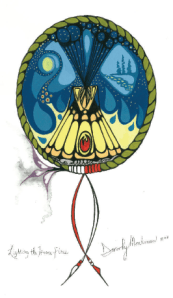
Sacred Circles are deliberate gatherings of people intent on being with the Creator to forge community and find common direction. Indigenous experiences of colonization and Residential Schools has led to a need for healing and reconciliation. This Sacred Circle will bring together Indigenous and non-Indigenous people of all ages to create an atmosphere of home and health and healing.
St. Peter, Dynevor Anglican Church has been home to two Sacred Circles.
Keynote Speaker
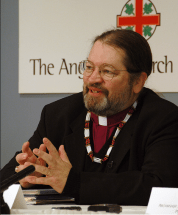 Mark MacDonald has served as the first National Indigenous Anglican Bishop since 2007. He was educated at Wycliffe College and traces some of his family heritage to Manitoba. Bishop Mark has travelled extensively across Canada, assisting Indigenous people in their journey of self-determination, healing and reconciliation.
Married on Nov. 11, 1989, Mark and his wife, Virginia Sha Lynn, have three children.
For an agenda, more information and to register,
download the Sacred Circle brochure.
Ministry Opportunity: Supporting Rio+20 Earth Summit in Prayer and Action
Earth Summit: Rio+20
“With hope, audacity and renewed faith, I call on the Anglican Communion around the world to assume their prophetic duty to ‘take care of Creation.”
– Brazilian Primate, the Most Rev. Mauricio Andrade
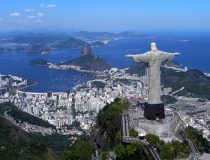
Rio’s Christ the Redeemer statue: a symbol for Christian support of the UN’s Conference on Sustainable Development.
The Earth Summit, the United Nations Conference on Environment and Development will be held in Rio June 13 to 22 to discuss a green economy and an institutional framework for sustainable development. The event will gather leaders from governments, the private sector and NGOs. As Christians, what can we do to participate in Rio+20?
Worshipping While Away
On the road? Find local Anglicans
Readings and Prayers
Looking for Readings and Prayers?
See the Revised Common Lectionary for readings for the coming week and a table of readings for the current season.
There are links to art and prayer for each week with scriptural reflections based on a featured art image, as well as RCL prayers for worship.
Thank you Vanderbilt Divinity Library for this wonderful online service.
 St. John's Anglican Cathedral