From the Deans’ Desks…

Mothering Sunday

Mothering Sunday is the Fourth Sunday in Lent. It is an old, somewhat odd, and uniquely Anglican tradition we’ve inherited from the Mother Church of the Anglican Communion-the Church of England. As with many old customs it has acquired many layers of meanings over time.

Mothering Sunday, Jerusalem our Mother

The Church – Our Spiritual Mother

Mothering Sunday originated in the Middle Ages where it was the custom for people to visit their home parish church or their cathedral – the “mother church” of the dioceses on this day. Mothering Sunday received its name from the scripture read in church that day. The epistle reading in both the mediaeval Latin Mass and Archbishop Cranmer’s Book of Common Prayer (1549) reads “Jerusalem which is above is free; which is the Mother of us all.” The ancient city of Jerusalem is literally the mother church of all Christians. For the early Christians Jerusalem (the “New Jerusalem”) is a metaphor for the Church as a mother whose children are born free in Christ (see Galatians 4:1-31 for full context). Just as a mother gives birth, feeds, and nurtures her children, so too the Church as a spiritual mother brings forth new life in Baptism, feeds her family with the Eucharist, and nurtures them with the wisdom her Scriptures and Tradition. St. Cyprian (AD. c.300-358) wrote that “No one can have God as Father who does not have the Church as Mother”. The Anglican Divines of the 16th and 17th centuries faithful to the teaching of the Church Fathers frequently addressed the Church as Mother in poetry, hymns and theology. John Donne (Anglican priest, poet and theologian 1572-1631) wrote, “And God gave me the light of faith when I was quickened [given life] in my second mother’s womb, the Church, by receiving my Baptism.”

The poem ‘The British Church’ also takes up this imagery:

George Herbert (Anglican priest and poet, 1593-1633)

I joy, dear mother, when I view
Thy perfect lineaments, and hue
      Both sweet and bright.
Beauty in thee takes up her place,
And dates her letters from thy face,
      When she doth write.


   A fine aspect in fit array,
Neither too mean nor yet too gay,
      Shows who is best.
Outlandish looks may not compare,
For all they either painted are,
      Or else undress’d.


   She on the hills which wantonly
Allureth all, in hope to be
      By her preferr’d,
Hath kiss’d so long her painted shrines,
That ev’n her face by kissing shines,
      For her reward.


   She in the valley is so shy
Of dressing, that her hair doth lie
      About her ears;
While she avoids her neighbour’s pride,
She wholly goes on th’ other side,
      And nothing wears.


   But, dearest mother, what those miss,
The mean, thy praise and glory is
      And long may be.
Blessed be God, whose love it was
To double-moat thee with his grace,
      And none but thee.


When the sun sets on Holy Saturday and the Church gathers for the Great Vigil of Easter, the resurrection of Christ is proclaimed as we sing “Rejoice O Mother Church! Exult in glory! The risen Saviour shines upon you!” (‘The Exsultet,’ Book of Alternative Services, p. 323).

From an article by Dean Rose, St. Peter’s Church, Oshawa.
With gratitude, Dean Johnson…


Worship for Mothering Sunday

March 10th, at 7:00 p.m.; Reception to follow in John West Hall

Sunday evening, St. John’s Cathedral will welcome the Rupert’s Land Diocesan community for the annual Mothering Sunday Service. Bishop Don will preside; Dean Paul will be the preacher.  This Eucharist will also include the affirmation of baptismal promises and ordination vows, as well as the blessing of oils by the Bishop for distribution to Diocesan parishes.  All are welcome.

Now this is an allegory: these women are two covenants. One woman, in fact, is Hagar, from Mount Sinai, bearing children for slavery. Now Hagar is Mount Sinai in Arabia and corresponds to the present Jerusalem, for she is in slavery with her children. But the other woman [Sarah] corresponds to the Jerusalem above; she is free, and she is our mother.      (Galatians 4:24-26)

Thanks be to God!

From the Dean’s Desk…

Ho, everyone who thirsts,bread-and-wine
come to the waters;
and you that have no money,
come, buy and eat!
Come, buy wine and milk
without money and without price.
Why do you spend your money for that which is not bread,
and your labour for that which does not satisfy?
Listen carefully to me, and eat what is good,
and delight yourselves in rich food.                                         (Isaiah 55:1-2)


“I am the vessel.
The draught is God’s.
And God is the thirsty one.”                            ~ Dag Hammarskjöld


What’s the food and drink we need most of all?

“This is my body which is given for you…  This cup that is poured out for you is the new covenant in my blood.”             (Luke 22:19-20)

What is the priceless drink to quench the deepest thirst of heart and mind and soul?
What is the richest food, the only food to satisfy our deepest longings?
What is the meal which turns us into vessels to quench God’s thirst for justice,
            into servants to satisfy God’s hunger for peace, for shalom?


“For as often as you eat this bread and drink the cup, you proclaim the Lord’s death until he comes.”                         (I Corinthians 11:26) 

Hungry yet?  The Table is spread; Christ is the host and he is the bread.
Thirsty now?  The Chalice is fine; Christ is the host and he is the wine.


I’ve just come from the fountain,
I’ve just come from the fountain, Lord,
I’ve just come from the fountain,
And his name’s so sweet!
            O sinner, do you love Jesus?
            Yes, yes, I do love my Jesus!
            O sinner, do you love Jesus?
            His name’s so sweet!            ~ African American spiritual  


Ho, everyone who thirsts,
come to the waters;
and you that have no money,
come, buy and eat!
 

Thanks be to God!

From the Dean’s Desk…

After these things the word of the LORD came to Abram in a vision, “Do not be afraid, Abram, I am your shield; your reward shall be very great.”           Genesis 15:1

“These things” refers to many and various wonderful words and deeds of God in relating to Abram and Sarai, including the promise of land, offspring (“a great nation”), and blessing such that through Abram and Sarai “all the families of the earth shall be blessed.”  All that is in the first three verses of Genesis 12; soon after, in Genesis 13, God repeats the promise, this after God has saved Abram from his own foolishness in Egypt.  And the story goes on in like manner; we know, of course, that both Abram and his wife are, well, elderly, and are somewhat sceptical about the promise of offspring beyond counting.  And that comes out in Sunday’s text…

But Abram said, “O Lord GOD, what will you give me, for I continue childless, and the heir of my house is Eliezer of Damascus?”              Genesis 15:2

Thank the LORD for the very human being Abram/Abraham and his wife, also a very human being, Sarai/Sarah.  What would we do without them?  I love them both, and am smiling as I write, heart full of gratitude for these great un-heroes of the faith, and more inspiring for it.  I relish these stories of Abraham and Sarah which together make a saga of real-life people journeying a pretty bumpy road of faith with God.  It’s not bumpy because of God – still getting the blame for that in our own day and age – but bumpy because of the very real humans who live this story, who journey in faith, or not, with God who is always faithful.

Stars without number

[God] brought [Abram] outside and said, “Look toward heaven and count the stars, if you are able to count them.” Then he said to him, “So shall your descendants be.” And he believed the LORD; and the LORD reckoned it to him as righteousness.                                                                               Genesis 15:5-6

So here the LORD, ever patient, repeats the promise yet again, and it appears for a moment that Abram is actually growing in faith; after God has stated the promise three or four times, Abram finally “believed the LORD.”  God’s response?  Very graceful, very generous:  “The LORD reckoned it to [Abram] as righteousness.”  Just for good measure the LORD reminds Abram about the land part of the promise, grace upon grace!

Then [God] said to him, “I am the LORD who brought you from Ur of the Chaldeans, to give you this land to possess.”                           Genesis 15:7

And, very reliably, much like me (You too?) Abram reverts to his normal, bumpy faith.  Abram’s doubt rises up to gnaw at the roots of his faith.

But he said, “O Lord GOD, how am I to know that I shall possess it?”                 Genesis 15 :8

There follows then a rather gruesome description of ancient sacrificial rites, but this makes it very clear that God is deadly serious about keeping God’s promises, and also that in this world of Abram’s, millennia ago, we might as well be on another planet in terms of cultural differences between us and them, differences so vast as to be almost unbridgeable, except for the happy reality that God is the Sovereign of every place and time, and in every time and place God is faithful, no matter how bumpy our faith journey might become.

As I was reading and re-reading this text, it occurred to me what serendipity it is that we have it for our inspiration and encouragement on the Sunday of our Annual General Meeting.  How beautiful that we, with our own doubts and questions, our own bumpy road of faith – all of which we bring with us to a ‘business’ meeting like our AGM – can look back at this wonderful saga of God’s faithfulness in a time of uncertainty, of fear about the future, with people very much like us, who find it so difficult to rest in God’s promises.  We ourselves can look back and see over and over again how God has been faithful in our own lives and in our life together in the church, and in the life of the church itself through twenty centuries, and yet our own fear often overwhelms our faith.

As the sun was going down, a deep sleep fell upon Abram, and a deep and terrifying darkness descended upon him.                            Genesis 15:12

Yes, the church is changing, and dramatically so in our North American context; the church that some of us thought would last forever no longer exists; there might be some real doubt, certainly is in my mind, that the church of our fantasies ever really did exist.  But we no longer live in a society where people are part of the church because it will help them get ahead in life somehow, or because it’s expected.  Call it the death of Christendom!  I call it good.  But, it can also feel like a deep and terrifying darkness, and too often we are responding out of fear, rather than trust in God’s faithfulness.  Panic permeates our planning, rather than prayer.  Hysteria takes over from hope.  All this was true also for Abraham and Sarah, and it’s often true for us, as individuals, as parishes – including our beloved Cathedral Parish – and it’s true for larger expressions of the church as well.

When the sun had gone down and it was dark, a smoking fire pot and a flaming torch passed between these pieces. On that day the LORD made a covenant with Abram…                                          Genesis 15:17-18

How is the covenant made?  “When the sun had gone down and it was dark.”  When the whole world looks different and we can no longer see everything, or much of anything, guess what?  God is still present with us, no matter what, always faithful, always keeping covenant, always keeping God’s promises.  That’s just as true now as it was long ago.

The apostle Paul, writing from a prison cell to the Philippians, reminds us of the same truth, except he says it’s even more clear now, since God’s faithfulness, God’s indefatigable love, has been most clearly revealed in Jesus Christ, crucified and risen.  The church may look and feel different, and we may feel unsure, unsteady, but the future which God has planned is nothing short of glorious.  In fact, Paul pretty much guarantees that there will be change, or he tells us that God at work in Christ Jesus guarantees it.  And, oh, by the way, that’s a good thing!

[Christ] will transform the body of our humiliation that it may be conformed to the body of his glory.                                                          Philippians 3:21

So, even if the future is not altogether clear for us, that’s OK.  We can go on, even into an AGM, at peace in God’s faithfulness, knowing that Christ himself is at work among us, to transform us into what God desires for us and for the world, this world loved so much by God.

Thanks again, Abram/Abraham and Sarai/Sarah, for this word of encouragement as we look forward to our AGM.  Knowing all this, the gathering becomes a celebration, a time for thanksgiving, rich in hope for our future in Christ, whatever that will look like we know that it will be rich in joy.

Thanks be to God! 

From the Dean’s Desk…

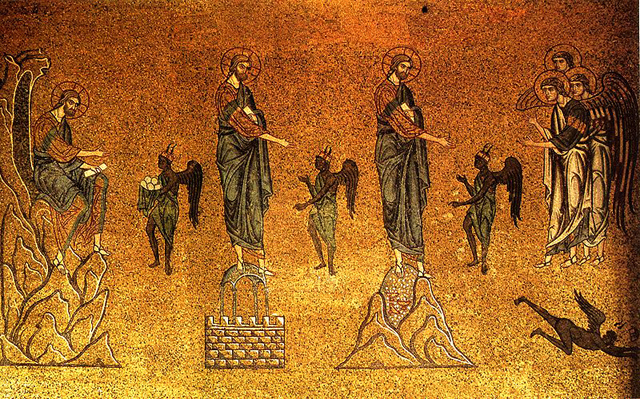
This beautiful image, from the Basilica of St. Mark in Venice, is from the 12th century and portrays the three temptations of Christ.  Part of the brokenness of our world — our surrender to temptation — is also revealed in this spectacular piece of art:  The portrayal of the devil as black, while Christ and the angels are all white.

Xp-temptation-stmarkbasilica

Then the devil took him to Jerusalem, and placed him on the pinnacle of the temple, saying to him, “If you are the Son of God, throw yourself down from here, for it is written,

            ‘He will command his angels concerning you,

            to protect you,’

and

            ‘On their hands they will bear you up,

            so that you will not dash your foot against a stone.'”

Jesus answered him, “It is said, ‘Do not put the Lord your God to the test.'”  When the devil had finished every test, he departed from him until an opportune time.                                                                        (Luke 4:9-13)

There is an idea abroad which reduces the Bible to some sort of magic talisman.  The ultimate end of this misguided approach is what some have called, I think for good reason, a kind of bibliolatry, worship of the Bible, rather than worship of God, revealed most clearly in God’s living Word, Jesus Christ.

It is never enough simply to fling Bible passages at each other, no matter what the issue, no matter who the ‘flinger’ and no matter what the Bible passage.  The Gospel for this first Sunday in Lent is Luke’s powerful account of Jesus’ temptation.  Yes, our Lord knew his Bible, was clearly immersed in the Hebrew Scriptures, and used them to focus his heart and mind.  Yes, he even quoted some verses to the tempter, but you cannot read this passage without noting that the tempter also quotes the Bible right back, hurling Psalm 91:11-12 in Jesus’ face.

Please don’t misunderstand me; I am pretty certain that many Anglicans, and Lutherans, for that matter, could benefit hugely from a more regular study of the Bible, and more use of the Scriptures in personal devotion as well, including this Lutheran-serving-Anglican.  But our faith is not so much about facts as it is about relationship, with the living God in the crucified and risen Lord Jesus Christ, and with one another.  Our faith is not so much about memorizing commandments/canons/constitutions as it is about re-membering, that is, being joined as members to the body of Christ, who is alive and at loose in this world which God loves so much.  And so our faith is not so much about sitting in one comfortable, cozy place – however that’s defined for each of us and for all of us together – as it is about journey.

We journey together with Jesus, disciples in the way of the Cross.  This is our Lenten journey, for sure, but it is also our lifelong journey.  Jesus says to his disciples in every age, take up your cross and follow me.  He does not say, ever, in any age, take up your catechism/canons/Cranmer/Luther, or even your Bible, and make yourselves comfortable.

But the journey, as difficult as it may be, is not condemnation to doom and gloom.  Wherever Christ leads, and he may will lead us into surprising places, on a journey which costs us our life (We no longer belong to ourselves!), his promise is joy far beyond fickle happiness, and peace which surpasses human understanding.

As an English Lenten carol of the seventeenth century has it:

Into the desert I was led

Where I fasted without substance;

The devil bade me make stones my bread,

To have me break my true love’s dance:

Sing, O my love,

O my love, my love, my love;

This have I done for my true love.

By the way, do think about joining us on Sunday mornings at 9:15 in the Cathedral narthex (back of the church) for the Dean’s Forum.  We’re spending some time every Sunday in study of the Bible, including much rich conversation, which I have called Dusting Off the Bible.  Right now we’re in the middle of the book of Exodus, an amazing and wonderful story of God who is love, God the liberator.  It’s an amazing story any time, but perhaps especially as we journey in Lent with Jesus who is love, who in his cross and resurrection liberates us from sin, death, and the power of the devil.

Thanks be to God!

From the Dean’s Desk…


The date of Ash Wednesday is always determined by the date of Easter, and now you know…

Ash Wednesday

But what about Easter itself?

Why does it keep moving around?  The date of Easter, the Resurrection of Our Lord, is determined by looking for the first Sunday after the first full moon after the Vernal Equinox.  Does this make sense to you?  Well, I couldn’t possibly comment, but the fact that the date of Easter is at least beginning to be a topic for conversation within some parts of the worldwide body of Christ is encouraging, if not dramatically so.  You see, the eastern part of the Christian Church, which, although many different and autonomous bodies, not all of which are in communion with each other, uses an older calendar which was abandoned in the West several centuries ago, so the dates for Easter are, most years, different in western Christianity and Eastern.

We, in both the Anglican and Lutheran Communions, as part of the catholic, or western, tradition use the newer calendar, which means we always have Easter, and so the beginning of Lent, first.  This year, because Easter is pretty early – although not as early as it can be – Ash Wednesday is soon upon us.  In fact, it’s coming right up, on February 13th to be exact.  So will begin again our Lenten journey, our pilgrimage with our Lord Jesus to the Cross.

I have a suggestion for what to give up this year for Lent:  I suggest we give up the whole idea of giving up, as in scorekeeping with coffee or chocolate or, well, you fill in the blank.  That’s all far too trivial.  Historically, Lent was a time for people, mostly adult people, to prepare for Baptism at the Great Vigil of Easter (after sunset on the night before Easter Sunday).  We who have already been baptized are invited to renew that baptismal journey, our own suffering and dying with Christ, so that we may also be raised with him, and celebrate his Resurrection, and ours, for a whole week of weeks, the seven weeks between Easter Sunday and Pentecost Sunday.

It all begins with Ash Wednesday, a rather odd day, but an important one nonetheless.  I want to share with you a quote from the Introduction to A Lent Sourcebook, published by Liturgy Training Publications, a wonderful Roman Catholic publisher in Chicago:

“Ash Wednesday is a kind of baptismal branding.  We are marked on our foreheads with the cross of Christ, which is a tree of life to beckon us back to the garden, a ship’s sextant to guide us to harbor, a bronze serpent to save us from dying in the desert.

“Coming back to baptism is hard work, like pruning vines, like plowing the earth, like the discipline of training for a contest.  Of course, neither the hard work nor the training do the job.  All of us, the faithful and the elect and the penitents, will learn this once again, when Lent is over and we have failed but God has not.”

Please join us at the Cathedral on Wednesday evening for 7 p.m. Ash Wednesday Eucharist, including the Imposition of Ashes, as once again we begin our walk with Christ, to that glorious time when we know again that “we have failed but God has not.”

What else can be said?  Thanks be to God.

From the Dean’s Desk…

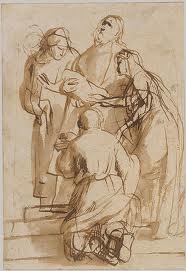
Xp-presentation-RubensCandlemas?  Pop quiz for all the Anglicans in the crowd:  What is Candlemas anyway?

“By the 11th century, the custom had developed in the West of blessing candles on the Feast of the Presentation. The candles were [brought] then lit, and a procession took place through the darkened church while the Canticle of Simeon was sung. Because of this, the feast also became known as Candlemas.”  (Scott P. Richert)

Blessing of the candles?  Well, yes, this was when traditionally all the candles to be used in the coming year were brought into church for a blessing.  So it was the festival of the candles, and worship always included the Mass, so it became Candlemas.  Through the centuries it also became part of the secular, or at least the academic, vocabulary as well.  At Oxbridge the two terms of study historically began on Michaelmas (29 Sept.) and Candlemas (2 Feb.).  Both Oxford and Cambridge now use a three term academic year.

The day’s full, official title on the liturgical calendar is The Feast of the Presentation of Our Lord in the Temple.  This is always the 2nd of February, or 40 days after Christmas, the required time in the Law of Moses for the purification of a new mother of a son, double the time required if she had a daughter.  See Leviticus 12.

So Mary and Joseph brought the forty day old Jesus to the temple in Jerusalem, where they were met by Simeon and Anna, two old and very faith-full people.  You can read the story in Luke 2:22-40, the Gospel text assigned for the day.  Since The Presentation falls on Saturday we aren’t using these texts in our celebration of the Resurrection on Sunday, but I invite you to read through all the texts, especially the Gospel reading, and reflect on this part of Jesus’ life, and the wonderful servants who supported him, Mary and Joseph first, of course, but also Anna and Simeon.  Having read these texts, and seen the wonderful connection between the story and light (again), prayerfully consider how this is also your story.

Here is Simeon’s song of thanksgiving to God for the Saviour, having seen the baby Jesus, and held him, traditionally called the Nunc Dimittis, from the first words of the Latin text:

‘Master, now you are dismissing your servant in peace,

according to your word;

for my eyes have seen your salvation,

which you have prepared in the presence of all peoples,

a light for revelation to the Gentiles

and for glory to your people Israel.’

Thanks be to God!

John Mullan, 9 December 1930 – 5 January 2013, Rest in Peace

JOHN MULLAN, JR. C.M.A., C.G.A.

John MullanFamily’s Obituary:

December 9, 1930 – January 25, 2013  It is with extreme heavy hearts we announce the passing of husband, father, grandfather and great-grandfather. John passed away peacefully at home surrounded by his family. He leaves behind his wife Norma and their five children: Chris, Kara, Carolyn, Scott and Sean. He is survived by 11 grandchildren and two great-grandchildren. He will be missed by his constant companion, his dog, Starlit. We would like to thank The Very Reverend Paul N. Johnson of St. John’s Cathedral for his support during this difficult time. The family would also like to express their deepest gratitude to the Palliative Care Team, especially, Olga. Please join us in a celebration of John’s life on Saturday, February 2, 2013 at 1:00 p.m. at St. John’s Cathedral, located at 135 Anderson Ave. Flowers are gratefully declined, but a donation to the Winnipeg Humane Society would be appreciated.

As published in the Winnipeg Free Press on January 30, 2013

Rest eternal grant to him, O Lord.  And let light perpetual shine upon him.

From the Dean’s Desk…


A Paraphrase of I Corinthians 12:12 – 31a  (with just a hint of Luke 4)

Helmut Harder, James Weisgerber, Elaine Sauer, Don Sjoberg, Lee Luetkuehoelter, Don Phillips, Lawrence Huculak, Susan Johnson, Emilius Goulet,

For just as the human body is one and has many members, and all the members of the body, though many, are one body, so it is with Christ (whatever the church/we, in its/our sinfulness,  may choose/s to express).  For in the ONE Holy Spirit we were all baptized into ONE body — white or aboriginal, rich or poor — and we were all made to drink of ONE Holy Spirit.

Indeed, the human body does not consist of one member but of many (Oh, if only St. Paul had known!), and so it is with the body of Christ.  If the liberal Christian would say, “Because I am not a literalist, I do not belong to the body,” that would not make it any less a part of the body.  And if the conservative Christian would say, “Because I am not a political activist, I do not belong to the body,” that would not make it any less a part of the body.  If the whole body were Roman Catholic, where would the Pentecostals be? If the whole body were Pentecostal, where would the Orthodox be?  But as it is, God arranges the members in the body, each one of them, as God chooses.  If all were Lutheran, where would the body be?  As it is, there are many members, yet one body of Christ.  The Anglican in Ontario cannot say to the Anglican in the Arctic, “I have no need of you,” nor again the Anglican in the Arctic say to the Anglican in New Westminster, “I have no need of you.”  On the contrary, the members of the body that seem to be weaker are indispensable, and those members of the body that we think less honourable we clothe with greater honour, and our less respectable members are treated with greater respect;  whereas our more respectable members do not need this. But God has so arranged the body, giving the greater honour to the inferior member, that there may be no dissension within the body (Ed. Note:  Well, we sort of manage one week a year, the Week of Prayer for Christian Unity… Can you work with that, God?), but the members may have the same care for one another.  If one Christian or one Christian church suffers, all of us suffer together with him/her/it.  (Ed. Note:  !!!!!!?????)  If one member is honoured, all rejoice together with it.  (Ed. Note:  That sounds a little more palatable.)

Now you (PLURAL, all of you, together) are the body of Christ and individually members of it.  And God has appointed in the church first apostles, second prophets, third teachers; then deeds of power, then gifts of healing, forms of assistance, forms of leadership, various kinds of tongues.  God appoints, God chooses.  Are we listening carefully?  Are all apostles?  No, that would be too many.  Are all prophets?  No, we have a hard enough time with the ones we already have.  Are all teachers?  No, but we could use a few more!  Do all work miracles?  Hmm… You see, we do need others after all.  Do all possess gifts of healing?  That would be great!  But do we even recognize those who are already among us, the healers already at work?  Do all speak in tongues?  Not in our part of the household of faith, probably, but, remember again, it’s much bigger than us!  Do all interpret?  No, they don’t, although more probably could, if they set heart and mind to it…  But strive for the greater gifts.  And what might those be, Saint/Brother/Father Paul?  What is that more excellent way?

“The Spirit of the Lord is upon me,

because he has anointed me

to bring good news to the poor.

He has sent me to proclaim release to the captives

and recovery of sight to the blind,

to let the oppressed go free,

to proclaim the year of the Lord’s favour.”

What’s that you say?  That’s not just about Jesus?  It’s about me?  About us?  About the people of St. John’s Cathedral, Winnipeg, and the Diocese of Rupert’s Land and the Anglican Church of Canada and the Anglican Communion and the whole household of faith, the Oikoumene, the whole body of Christ in the world?  Ah, I see, and that brings us back to where we began, doesn’t it?

“For in the one Spirit we were all baptized into one body — Jews or Greeks, slaves or free — and we were all made to drink of one Spirit…  Now you are the body of Christ and individually members of it.”

Thanks be to God!

From the Dean’s Desk…


Water-into-wine
Now standing there were six stone water jars for the Jewish rites of purification, each holding twenty or thirty gallons.  Jesus said to them, “Fill the jars with water.” And they filled them up to the brim.  He said to them, “Now draw some out, and take it to the chief steward.”  John 2:6-8

What grace water has, before God and before his Christ, for bringing out the meaning of baptism!  Christ is never unaccompanied by water.  He himself is baptized in water, and when he is invited to a marriage, he uses water in making his first show of power…  His witness to baptism continues right up to his passion.                                                              Tertullian, c. 160 – c. 225 AD

More than ever before in human history we are beginning to understand that, for sustaining physical life, water ranks right alongside the air we breathe.  This helps us to understand more clearly than ever before, I believe, the beautiful and powerful importance of water for sustaining spiritual life also.

In the synoptic accounts (syn-optic being from the Greek words which mean ‘to see together’)  of Matthew, Mark, and Luke, Jesus is baptized by John in the water of the River Jordan, and then spends time in the wilderness , with almost no water, where he is tempted by the fierce power of evil.  In John’s Gospel, Jesus is still baptized by his cousin in the water of the Jordan, but then he begins immediately to start calling his disciples.  Baptism is one day, calling disciples is the second day, and ‘on the third day there was a wedding…’

Water is basic, essential, in all the Gospels, and so is Jesus’ baptism.  His final baptism is his death on the cross, where he is immersed completely, utterly, finally, in the human experience, our experience, even our sinfulness, and he is totally overwhelmed by all of our brokenness.  Maybe you remember Jesus’ question to James and John:  “Are you able to drink the cup that I drink, or be baptized with the baptism that I am baptized with?”  That’s the Cross!  That’s death.  But, as we know, that isn’t the end of the story.  After Good Friday, there is Easter; after the Cross, there is resurrection.

We are joined, all disciples everywhere and every-when, to Christ and his cross and resurrection in the waters of death and life, with water, H20, and the promise of God.  We participate in him, in his life now and forever through the grace of God given in God’s eternal promises, and in the miracle of water joined with those promises.

Water itself is a great miracle, a marvelous gift of God, without which life as we know it would not be possible.  Even in Jesus’ first public statement of his identity, water plays an integral role.  There would be no exquisite wine at the wedding in Cana if there were not first those six stone jars full of exquisite water.  Even Jesus needed water, for life, for ministry, for amazing grace.

What if we could have the faith of his blessed mother, his long-suffering mother?  Who knows what might happen if we were to trust in him completely, as she did, so that even as she sighed she was able to tell the servants, “Do whatever he tells you.”  Just think what wonders we might do together; just think of the powerful witness there could be to God’s love at work in this world, this wounded world where so much water is wasted, where so much blood is spilled.  Who knows?  We might even be able to change dying lakes into the sparking bodies which once they were.  Perhaps more rivers could be brought back to life, filled again with fish.  Maybe even the oceans of the world, the lungs of the world, could be brought back from the brink, and be restored to health once more.  Might it even be possible, that the poisonous and broken relationships which plague us all, from painfully close to globally painful, could be healed?

Pour the water!  Pour the wine!  Either way Jesus is alive and working still, in spite of us, and even more wonderfully, through us, so that God’s vision for the future will come to pass.  Come to the Wedding Banquet.  You see, the very best is still to come.  Thanks be to God!

From the Dean’s Desk…

Baptism of JesusAnd a voice came from heaven, ‘You are my Son, the Beloved; with you I am well pleased.’       Luke 3:22b

We had two good weeks away, time to be with family in Washington (the real one, just south of BC) and Minnesota, to see friends, to rest and relax and read, thanks be to God.  We arrived home safely on Thursday night before freezing rain and then blizzard.  I spent a little time here in the office yesterday, Friday, and then in the evening went to the Bishop’s annual Twelfth Night Dinner, always a pleasant event.

Today, Saturday, I spent some time at home in the morning, then went to St. Boniface Hospital to see an ailing parishioner, and then came back here to finish up the sermon for tomorrow.  A couple more things to do to finish getting ready for tomorrow, so I took a little break and did some browsing on Facebook,  where I came across this little piece, with its wonderful accompanying image (above).  I couldn’t resist sharing it, especially as they seem to agree with what I want to say tomorrow!  See you in church?

“This weekend as we celebrate Jesus’ baptism, we remember it as the moment when he embraces his humanity, figuratively getting into the pool with us. We also remember our own baptism when we get into the pool with him to be immersed in his life.”

Catholic News Service, “Word to Life” series on Sunday’s readings, The Baptism of Our Lord.