From the Dean’s Desk…

IMG_1925

And let us consider how to provoke one another to love and good deeds, not neglecting to meet together, as is the habit of some, but encouraging one another, and all the more as you see the Day approaching.                              Hebrews 10:24-25

I write this at Wilderness Edge Retreat and Conference Centre situated on the Winnipeg River in  Pinawa, Manitoba.  For the second year, the clerics of the Diocese of Rupertsland and the pastors and professional leaders of the ELCIC Manitoba Northwestern Ontario Synod are meeting together for our annual study days.  Our Full Communion relationship under the terms of the Waterloo Accord continues to deepen and grow.

We are about sixty or seventy priests, deacons, pastors, and other professional leaders from the Manitoba Northwestern Ontario Synod of the Evangelical Lutheran Church in Canada (affectionately known as MNO, since the other takes several breaths to say) and the Diocese of Rupertsland.  Our speaker is inviting us into a serious look at what it means to live as disciples of Jesus in the 21st century.  Our annual gathering began Tuesday evening with a celebration of the Eucharist together.  Yesterday we listened to our guest speaker in two sessions in the morning.  After a free afternoon, we gathered in the evening in the two groups, Anglican and Lutheran, to spend a little time on more local issues and questions.  The official agenda ended with both groups together again with Evening Prayer, even as we had begun with Morning Prayer.  Today again, Morning Prayer followed by two more sessions with Stephanie, who will speak to us again this evening, before we share in Evening Prayer, and once more tomorrow morning after we open the day with Morning Prayer.

The Rev. Stephanie Douglas-Bowman is Associate Priest at Christ Church (Anglican), Brampton, in the Diocese of Toronto.  She has a B.A. in linguistics from McGill and an M.A. in theology from Wycliffe College at the Toronto School of Theology.  Officially the name of our conference is ‘Discipleship:  Christian formation in multiple contexts.’  This fits beautifully with our Diocesan focus of Discipleship: Discovery, Development, Deployment.  Stephanie’s presentations are rich, the conversations with her and around the presentations even richer.

But it is the gathering as a whole, with the presentations included, of course, that is the greatest blessing.  It’s a time for all of us who are priests, deacons, pastors, bishops, and other professional leaders in the church to deepen friendships and make new ones, to strengthen working relationships, or to mend them if they need mending, to support those among us who are feeling bruised and battered, and mostly just be together in worship, and fellowship, sharing meals, and relaxation and recreation.  It is a very important gathering for us, and, I think, good for the rest of the church in our diocese and synod.  I appreciate very much the opportunity to be here, and am glad that the bishop requires it of us.  Here we can indeed “provoke one another to love and good deeds… encouraging one another.”

Thanks be to God!
From the Dean’s Desk…

Letting the captives free

Happy are they who have the God of Jacob for their help,
whose hope is in the LORD their God;
who made heaven and earth, the seas, and all that is in them;
who keeps promises forever… (Psalm 146:5-6)

I have actually heard people say that our Christian faith is a very personal matter only and we must never discuss ‘religion and politics’ or that the Church needs to stay out of politics, has no business sticking its nose into politics, or business, for that matter. Even more disturbing, I have actually heard people say, argue passionately, that the Bible really has nothing to say about faith except our personal, quiet, interior, non-public expression thereof. Hmmm…

I agree wholeheartedly with the separation of church/synagogue/mosque/temple/gurdwara, etc. and state, but this does not mean we should be silent in the public square, as it is just that: Public. We all share in the conversation space called ‘public’ and that includes people of faith and no faith alike. That’s called democracy.

Especially frustrating – I now make public confession – are those Christians of whatever stripe who argue that ‘there will always be poor’ and God has blessed the rich, etc., etc. It’s just too bad, they’re poor only because they’re lazy, etc., etc. Kyrie eleison! Lord have mercy!

[The LORD] gives justice to those who are oppressed,
and food to | those who hunger.
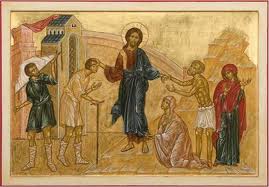
The LORD sets the captive free.
The LORD opens the eyes of the blind;
the LORD lifts up those who are bowed down;
the LORD loves the righteous.
The LORD cares for the stranger;
the LORD sustains the orphan and widow… (Psalm 146:7-9)

The Bible is actually brimming with material saying – which at least Christians need to hear, and not skip over – that God cares very much indeed how a society is run (politics) and how the supposedly free market operates (economics, based on the Greek word having to do with how the household – oikos – is organized – nomos). The Older Testament is absolutely chock ablock with passages like this Psalm for Sunday, overflowing with God’s care and concern for the poor and the oppressed, for the stranger, for the widow and the orphan. Jesus also makes it very clear, in revealing the heart and mind of God to us, that he is very, very concerned about justice. All you have to read is his mission statement in Luke 4 and his vision statement in Matthew 25, much less his numerous references to the Kingdom/Reign of God throughout all the Gospels.

Our faith – and the New Testament never really speaks about ‘my’ faith – is not just about the sweet hereafter, but about God’s mercy for this world, God’s passion for justice in this world, God’s love of all the people of this world, and God’s claim on this world which remains God’s garden, not our playground or hunting/fishing resort or mine-pit or dumping ground. God is faithful, and God keeps God’s promises forever. Thankfully, in Christ we know that God does not keep score, that God’s grace abounds, that there is hope for us. That really is good news, sisters and brothers, that really is the Gospel.

The LORD shall reign forever, your God, O Zion,
throughout all generations. Hallelujah! (Psalm 146:10)

Thanks be to God!

The Service of Ordination as Deacons in the Church of God

Veni Sancte Spiritus-5

Ordination of

Allison Christine Chubb     Helen Wanda Holbrook
Kara Dawn Mandryk     Lissa May Wray Beal

as Deacons in the Church of God, within the Anglican Church of Canada

3:00 p.m.
Sunday, 9 June 2013
Commemorating the Feast of St. Barnabas
The Rt. Rev. Donald D. Phillips presiding
The Rev. Jamie Howison preaching


The Cathedral Church of St. John the Evangelist
135 Anderson Avenue
Winnipeg, Manitoba
R2W 5M9

https://maps.google.com/maps?q=135+Anderson+Ave,+Winnipeg,+MB,+Canada&hl=en&sll=49.853822,-97.152225&sspn=0.480776,1.352692&hnear=135+Anderson+Ave,+Winnipeg,+Manitoba+R2W+1E2,+Canada&t=m&z=16

From the Dean’s Desk…

Cantate Domino, flowers

Sing to the LORD a new song; sing to the LORD, all the earth.
Sing to the LORD, bless the name of the LORD;
proclaim God’s salvation from day to day.
Declare God’s glory among the nations and God’s wonders among all peoples.
Psalm 96:1-3

NB: As always, anything good here is for God’s glory, but this one I would like to dedicate also to my father’s memory, Thomas Johnson (1916-2001), and to honour my mother, Elisabet Johnson, who is still very much alive and making music for God’s praise with her life, as well as with her piano. Thanks, Mom!

One of the many gifts my parents gave me was a love of singing, and a recognition that song, at its best (another word on that in a moment), is both a gift from God and our gift to God. “At its best” simply means that we do our best, such that, even if we might think we can’t carry a tune in a bucket, we still lift our voices and “make a joyful noise to God.” (See Ps. 66:1; 95:1,2; 98:4,6; 100:1), and if perhaps we have been blessed with more musical ability then we use that also, to the best of our ability, for the praise of God. But, most especially, we seek to make a song of praise of our lives and of our life together.

Part of our family life as I was growing up was family devotions, and not just once a day, but twice a day! As I look back on that now, I am very grateful to my Mom and Dad for that discipline, although as a six year old I wasn’t always 100% thrilled every single time. After breakfast and again after the evening meal my Dad would read from the Bible – if he wasn’t at work, in which case Mom read – and then a devotional reading from a book, after which we prayed together. In the evening we also sang together as a family; for a long time our tradition was to learn a new hymn every week so that, at the end of every week, we could literally “sing to the Lord a new song.”

My folks had ordered a pump organ from Germany, which eventually, after a long sea voyage, arrived at our home in Madang, in what was then Australian Territory of New Guinea. My mother would play that organ with gusto and we would all sing. I learned the beauty and wonder of joining with the heavens and the earth, with field and forest, in rejoicing before God the Creator in song, of not only listening for the music of the spheres but helping to make it.

Sadly for the organ the local termites made their own kind of music, and it wasn’t joyful. It was a dreadful dirge they made, a relentless death march of chomp, chomp, chomp; it was nothing short of constant warfare. My mother tells me that she lost the war with the termites over the organ, and eventually the poor thing succumbed, and was silenced. But not before we used it for years in making a joyful noise to God, singing to the Lord a new song!

Let the heavens rejoice, and let the earth be glad; let the sea thunder and all that is in it;
let the field be joyful and all that is therein.
Then shall all the trees of the wood shout for joy at your coming, O LORD,
for you come to judge the earth.
You will judge the world with righteousness
and the peoples with your truth.
Psalm 96:11-13

We are all invited into this song of the cosmos, this universal hymn of praise in which the creation itself participates. Our worship together is part of this glorious chorus of praise, in which we join with the whole universe of every age, with all people and all creatures not only in this age but through all the ages, with all the angelic hosts of heaven, as well as with the mighty choir of all the saints who have gone before. With voice, yes, but also with heart and mind and spirit, and with all we do and say, knowing what we do of the immense and immeasurable love of God in Christ Jesus crucified and risen, how can we not join the song?

Thanks be to God!

The God Who Only Know Four Words

Postscript – From the Dean’s Desk… Thank you, Marilyn Scheske!

Every childTrinity, dancing
has known God.
Not the God of names,
Nor the God of don’ts,
Not the God who ever does
anything weird.
But the God who only knows four words
And keeps repeating them, saying:
“Come dance with Me.”
Come.
Dance.
—Hafiz

From the Dean’s Desk… Trinity Sunday

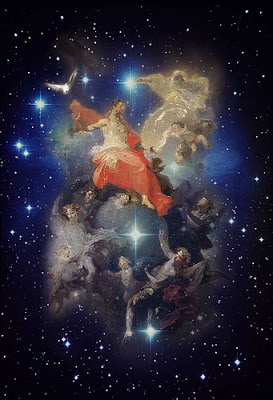
Trinity, icon

Come, join the dance of Trinity, before all worlds begun –
the interweaving of the Three, the Father, Spirit, Son.
The universe of space and time did not arise by chance,
but as the Three, in love and hope, made room within their dance.


The above is the first verse of a wonderful twentieth century hymn by Richard Leach, who was born in 1953.  His poem is set to that classic English folk tune, Kingsfold.  Played properly, it really does make you want to get up and join in the dance of Trinity.  The hymn was not published until 2001, after the publication of Common Praise, but in time to make into Evangelical Lutheran Worship (#412).

I find the language so helpful, so lifegiving, so beautifully open, compared to the blood, toil, tears, and sweat of centuries, indeed, millennia, of verbal jousting, conflict, and murder itself, all in the name of Trinitarian argument, as if God depends somehow on us getting it exactly right.

Don’t misunderstand me; theology is important, but the history of the church includes far too much sorrow and bloody death in ‘discussion’ on the nature of the Trinity.  Thank God, most of the blood has stopped flowing – among Christians, on this topic at least – but there is still too much of what I might term violent separation – all in the Name of the One who prayed that we might be one – and a feeble, fickle witness to the world, at best.

Lately, I’ve been reading a great book called Christianity:  The First Three Thousand Years by Diarmid MacCulloch, who teaches at Oxford University.  I’m only just nicely into it; as you might guess, it’s a rather lengthy tome.  But much of what I’ve read so far has to deal with enormous efforts first to try to define that which cannot finally be defined, to pin it down on a theological collector’s board, and then, second, to fight like hell (Yes, that’s what I meant to say…) with everyone who disagrees with you.

All right, do the work, fine.  It needs to be done.  But how about living this way?

Come, speak aloud of Trinity, as wind and tongues of flame
set people free at Pentecost to tell the Saviour’s name.
We know the yoke of sin and death, our necks have worn it smooth;
go tell the world of weight and woe that we are free to move.


Sisters and brothers, enjoy the dance, savour the mystery, rejoice in the divine gift of relationship.

The grace of the Lord Jesus Christ, the love of God, and the communion of the Holy Spirit be with all of you.  (II Corinthians 13:13)

Thanks be to God!

From the Dean’s Desk…

KONICA MINOLTA DIGITAL CAMERA

Very truly, I tell you, the one who believes in me will also do the works that I do and, in fact, will do greater works than these, because I am going to the Father. I will do whatever you ask in my name, so that the Father may be glorified in the Son. If in my name you ask me for anything, I will do it.                                John 14:12-14

Uh oh.  Do the works that Jesus does?  And, in fact, do greater works than Jesus does?  Oy vey!

How’s that going for you?  Speaking for myself, I’d have to say it’s not going so well, at least not most of the time.  Thankfully, though, I am not alone, not even in the human sense:  I am part of something which is global, the worldwide community of Christ, in all its diversity and beauty, in all its mystery and majesty and power, and, yes, all its problems too.   But it is much more than just a human institution (Thanks be to God!), it is universal, transcending time itself because it is the Body of Christ, of which we are all a part, of which the rich Anglican tradition is one expression, of which Jesus Christ alone is head.  In him, in his power of creative love, and in the encouragement of, and the partnership with, the whole community, Jesus’ works become possible, even for me, even for us, even for a very human church.  And even greater works because since Jesus of Nazareth made these promises to the first disciples, there have been and are billions of us spanning the millennia.

But how can all this even be possible?  The text makes it sound like Jesus went off and left us:  “I am going to the Father.”  Well, that’s how it sounds at first, and that’s how it sounded to the first disciples too, apparently, because clearly they needed some reassurance.  They got what they asked for, what they needed, not necessarily what they wanted, although that too would come.  To ask for something ‘in Jesus’ name’ is to ask to be in tune with the will of God.  It’s not to ask for winning numbers in the lottery, or a parking spot, or, you fill in the _______________.  The disciples asked for reassurance, they asked not to be alone, they asked for strength to do the seemingly impossible task given them.  They didn’t know it yet, but they asked for the Holy Spirit; they asked for Pentecost.

But the Advocate, the Holy Spirit, whom the Father will send in my name, will teach you everything, and remind you of all that I have said to you. Peace I leave with you; my peace I give to you. I do not give to you as the world gives. Do not let your hearts be troubled, and do not let them be afraid.                  John 14:26-27

On that first Day of Pentecost Jesus’ promise was fulfilled, and the one, holy, catholic, and apostolic church was born.  The Spirit of God, the Spirit of the risen Christ, was poured out in full measure on that small band of Jesus’ first followers.  In that power they moved out into the world, beyond Jerusalem and Judea, beyond Galilee and Tyre and Sidon, beyond, far beyond the world trod by Jesus of Nazareth, reaching greater audiences than ever he had, proclaiming the healing and reconciling Gospel of God’s love in Christ Jesus.  Thus, truly, in-Spired by Christ risen and present in all places through the Holy Spirit, they did greater works than Jesus of Nazareth, and the church was born.

We celebrate again the great Feast of Pentecost, the birthday of the church, third of three greatest festivals in the church calendar (along with Easter and Christmas), because we too are gifted with the very same Spirit.  We too are the church of Christ.  We too are blessed with the peace in abundance which the world cannot give.  We too are gifted with power enough to remake the world in partnership with God, if we are willing to let go of control and let God remake our hearts and minds also.  Are we, perhaps, afraid of a changing world, and a changing church?  No need.  “My peace I leave with you.”  Are we worried, fearful even, about an Anglican church, about a Cathedral parish, that won’t necessarily be the same forever?  No need. “Do not let your hearts be troubled, and do not let them be afraid.”

Maybe by now you know the old saying of which I am so fond:  “We don’t know what the future holds, but we know who holds the future.”  Pentecost is God’s seal on that.

Thanks be to God!

From the Dean’s Desk…

unity-called-to-be-one

Thank you to The Rev. Brian Ford for presiding and preaching today, as well as leading the Dean’s Forum, with a preview of the texts for next Sunday, the great Festival of Pentecost, one of the three greatest feasts of the church calendar, with Christmas, the Nativity of Our Lord, and the greatest of all, Easter, the Resurrection of Our Lord.

I’ll be back at work later this week, after enjoying a time of rest and re-creation in Minnesota with family and friends.  I look forward to being back at the Cathedral to celebrate with you for the Day of Pentecost, the gift of the Holy Spirit, and the birth of the church, the one, holy, catholic, and apostolic church, the whole Body of Christ in the world.

Thanks be to God!

From the Dean’s Desk…

Ocean of peace

Thank you to The Rev. Canon Tony Harwood-Jones for taking the worship services this coming Sunday, May 5th, at the Cathedral, and for leading the Dean’s Forum between services, with a look at the texts for the Ascension of Our Lord next week, always a Thursday, because it’s always forty days after Easter Sunday.

On Sunday week, May 12th, our Honorary Assistant, The Rev. Brian Ford, will preside and preach at both services, as well as leading the Dean’s Forum, with conversation around the texts for the Sunday after, May 19th, the third great Festival of the church calendar, the Day of Pentecost (from the Greek word for fifty), fifty days after Easter Sunday.  Thank you, Brian!  Our week of weeks, celebrating the Resurrection of Our Lord for forty nine days draws to a close.  But Pentecost remembers and gives thanks for the gift of the Holy Spirit to the church, promised by Jesus, and is thus traditionally celebrated as the birthday of the church, the whole church, the Body of Christ in the world.

I’m enjoying a time of rest and re-creation; I look forward to returning to the Cathedral in time to celebrate Pentecost with you, and to resuming my work in this parish in partnership with you, and in the Diocese of Rupert’s Land.

Thanks be to God!