From the Dean’s Desk…

publican_and_pharisee

[Jesus] also told this parable to some who trusted in themselves that they were righteous and regarded others with contempt: Two men went up to the temple to pray, one a Pharisee and the other a tax collector.  The Pharisee, standing by himself, was praying thus, ‘God, I thank you that I am not like other people: thieves, rogues, adulterers, or even like this tax collector.  I fast twice a week; I give a tenth of all my income.’ But the tax collector, standing far off, would not even look up to heaven, but was beating his breast and saying, ‘God, be merciful to me, a sinner!’ I tell you, this man went down to his home justified rather than the other; for all who exalt themselves will be humbled, but all who humble themselves will be exalted.”  (Lk. 18.9-14)

You know the how the old movie begins, right?  “A long time ago, in a galaxy far, far away…” Well, it’s a great fantasy, oodles of fun, but that’s all it is.  I want to tell you another story, the truest story ever, the story about a God, the God, the loving Creator of all that is, a God present right here, right now, in this moment, and not far away at all, but as close to us as our own beating hearts.  This God, the God revealed in many ways but most clearly in the life, death and resurrection of Jesus Christ, loves us so much, you, me, all of us together, our friends and our enemies, good people and bad, moral and immoral, that God refuses, absolutely refuses, to keep score.  No scorekeeping!

If that’s true, and I believe it is, why do we work so hard at it?  God isn’t interested!

Christ crucified bears all our humiliation; in him God swallows whole the power of death.  Christ risen raises us all, exalts us, gifts us with new life, with hope to endure anything, peace beyond the world’s understanding, and a call to service, to discipleship, to join with God and with one another in bringing in the new creation.  There all humiliation is finished, and all are exalted, the whole creation, God’s dream become reality, God’s passion for all of us and for everything that exists:  Healing, wholeness, reconciliation, true community, perfect shalom forever.

Thanks be to God!

Teaching the Faith in the Anglican Tradition: Learning for a Common Christian Life

Ephraim Radner lecture, Catechesis in the Anglican Tradition
The Rev’d Dr. Ephraim Radner (Wycliffe College, University of Toronto) will deliver a lecture entitled “Catechesis in Anglicanism: Learning for  a Common Christian Life.”  The lecture will be offered at St. Margaret’s Anglican Church, at 7:30 p.m., Thursday, October 24.
Professor Radner is one of the most respected theologians in the country and an engaging speaker. In his lecture he will reflect on how the Anglican church has taught its faith in the past, and assess current developments in a time of upheaval for the Anglican Communion both local and global.
Questions?
Julienne Isaacs,
Academic Assistant
Graham MacFarlane, Adult Spiritual Formation Intern
Saint Margaret’s
Anglican Church
160 Ethelbert St.
Winnipeg, Manitoba R3G 1V7

From the Dean’s Desk…

Forgiven_by_ejayne

But this is the covenant that I will make with the house of Israel after those days, says the LORD: I will put my law within them, and I will write it on their hearts; and I will be their God, and they shall be my people. No longer shall they teach one another, or say to each other, “Know the LORD,” for they shall all know me, from the least of them to the greatest, says the LORD; for I will forgive their iniquity, and remember their sin no more. (Jer. 31:33-34)

In the Gospel for today, Jesus tells still another parable which seems at first glance – maybe second too – a little strange, because we often misread it as a direct comparison between the judge and God. But it isn’t; it’s another of those Jesus sayings which contrasts rather than compares. If a sinful judge will grant justice because of the woman’s persistence, how much more will a gracious God do so? Will God delay long in helping them?

But what if God is revealed also in the persistent woman seeking justice? What if God will not give up on God’s passion for the whole creation, right relationship of all creatures within a healed creation?

When I read the Older Testament by itself, and then, for me as a Christian, read the New Testament after it, and I read the whole through the lens of cross and resurrection, I can only conclude – only conclude – that the love of God is persistent beyond our imagination.
The words of the prophet Jeremiah, speaking for the LORD, are a clear reminder of this; these words are, in fact, a powerful proclamation of God’s Gospel, revealed most clearly in and through the crucified and risen one Jesus the Christ.

I am often surprised that there is more to the Bible than the Book of Genesis, because, if I were the Holy One, I would have given up at the Flood, and not bothered to start over again, at least not with human beings. But, praise be, God’s thoughts are not my thoughts, and God’s ways are not my ways. Over and over again the people in the story of the Prime Testament blow it royally. Yes, they do suffer consequences for their breaking of relationship, but God never, ever gives up on them… or me. Or you. Or us. Or the world.

They shall all know me, from the least of them to the greatest, says the LORD; for I will forgive their iniquity, and remember their sin no more.

Thanks be to God!

From the Dean’s Desk…

Thanksgiving-list

Consider these words – in italics – from the Second (Epistle) Reading
for the Day of Thanksgiving, from St. Paul’s Letter to the Philippians,
for us in Canada, Monday, 14 October, for our friends to the south, 28 November:

Rejoice in the Lord always;
again I will say, Rejoice. 
Let your gentleness be known to everyone.
The Lord is near.
Do not worry about anything,
but in everything
by prayer and supplication with thanksgiving
let your requests be made known to God. 
And the peace of God, which surpasses all understanding,
will guard your hearts and your minds in Christ Jesus.

And, also, these words from Paul’s First Letter to the Thessalonians:
 
Thanksgiving-1Thessalonians5-18, Rock and Leaf_2


It is NOT God’s will that we give thanks FOR everything, just as it is not God’s will that we suffer and die in sometimes awful ways, and that the creation itself groans in travail.  However, it IS God’s will, desire, longing, that we learn, in the power of Christ, the One who is risen from the dead, to give thanks IN everything.  This is a key difference; it reminds us that giving thanks is a spiritual discipline, and a very healthy one, which will lead us into the way of peace, peace that the world cannot give, peace which surpasses all understanding.

Thanksgiving-for what you have

An attitude of gratitude will, in the power of the Holy Spirit, guard our hearts and minds in Christ Jesus, and, indeed, guard our very lives, no matter what may happen, no matter what circumstances we may face, we can live in that wonderful peace and know true joy.  That’s cause for giving thanks 365 days a year, don’t you think?

Happy Thanksgiving to one and all! And, most especially,

Thanks be to God!

Thanksgiving-In everything give thanks (in many languages)

From the Dean’s Desk…

Keeper of the Sacred Fire (Australia)

For this reason I remind you to rekindle the gift of God that is within you through the laying on of my hands; for God did not give us a spirit of cowardice, but rather a spirit of power and of love and of self-discipline.  (II Timothy 1:6-7)

When I was ordained as a Lutheran pastor, now more than 26 years ago, the person I asked to preach on that July afternoon in 1987, was (still is, for that matter) an older, wiser Lutheran pastor, Jerry Bongard, who had been very influential in my teen-aged years.  I regarded him then as both mentor and friend, and, indeed, for that matter, still do.  Jerry gave a wonderful and powerful sermon that day, most of which I’ve forgotten, but one line which will never leave me, was his description of my ministry-to-be as a ‘keeper of the sacred fire’.

Somehow, I was deeply moved by that word to me, the gift that Jerry shared with me so long ago – Thanks, old friend!  It was important to me then, and has become even more important to me now.  Every time I read this text from the Second Letter to Timothy, Jerry’s gift comes again to mind, with the reality it bears, as I’m reminded ‘to rekindle the gift of God that is within’ me.  I’m also reminded that there is a gift in all of us, pure gift, the fire of God’s Spirit (also translated as both breath and wind in both Hebrew (ר֫וּחַ) and Greek (πνεῦμα, ατος, τό), something always needed for rekindling work.

Faith is pure gift by which we experience another, related pure gift, the Gospel of Jesus Christ with its healing and life-giving power.  Yet, yet (Note well, not but, no ‘death of a thousand buts’ here…) these are gifts which must be nurtured, cared for tenderly.  Occasionally, it may seem, or feel, like the fire has gone out, and that’s when we need to rekindle the sacred fire within, or have it rekindled for us by someone else, in the power of the original Spirit, the Holy Wind from God.

In recent years, as I’ve moved into service with the Anglican Church of Canada (even while remaining on the ELCIC Roster, under the terms of the Waterloo Accord for Full Communion), I have been privileged and richly blessed to work more – if still in a small way – with Christian sisters and brothers who are also First Nations and, to a lesser extent, Métis and Inuit.  How important it is in the traditional cultures to keep the sacred fire burning, literally, as part of traditional customs and spirituality, but also now linked with Christian faith.

It shouldn’t be all that strange to some of us, whether Anglican or Lutheran; it’s just that, if we have maintained our sacred fires, we’ve enclosed them in red glass and brass and hung them up as ‘eternal flames’ (from the Hebrew as described in the Pentateuch), and we have designed them to burn quietly and without much attention, if any, for up to a week.  Well, it’s not quite so simple in more traditional cultures, where the fire must be nurtured, cared for tenderly, and rekindled when it burns low, as in the photo above from Australia.

Even so, our own spiritual fires burn low, whether as individuals, or as communities of faith, and they need rekindling.  Ultimately, (another gift) it is God’s Spirit which is the firekeeper, but always, in one way or another, sometimes in deep mystery, working through us, and often through all of us, not just those of us designated by the community of faith as ‘firekeepers’.

When we work together we work best, and the fire of faith and service in Christ’s name is rekindled:  For God did not give us a spirit of cowardice, but rather a spirit of power and of love and of self-discipline.

Thanks be to God! 


From the Dean’s Desk…

Michael and All Angels (September 29)

This year Michaelmas falls on a Sunday,
and so we remember, give thanks, and celebrate.
But, for a change, let me share some
of what others say about this remarkable day…
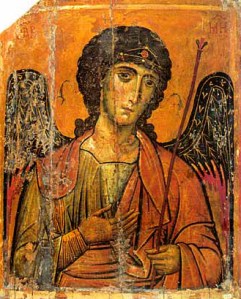
St. Michael the Archangel, icon from St. Catherine's Monastery, Mt. Sinai, 13th century

St. Michael the Archangel, icon from St. Catherine’s Monastery, Mt. Sinai, 13th century

Sundays and Seasons – A resource for worship from Augsburg Fortress Publishers
Overview:
Victory Is Hope


It is easy to be caught up in the drama of these readings [for the day]: war breaking out in heaven, a time of great anguish on earth, Michael and the angels battling with Satan. Even Jesus’ disciples—foolish though they may sometimes be—are given authority over demons in the name of Christ. Yet the significance of these readings lies not in the events described but in the power behind them: the death and resurrection of Jesus. The angels are victorious “by the blood of the Lamb and the word of their testimony” (Rev. 12:11), and in Daniel’s vision “those who lead many to righteousness” shine “like the stars forever and ever” (Dan. 12:3). Jesus says it best, however, when he warns the seventy not to rejoice in their power over evil but in the certainty of their salvation.

John August Swanson
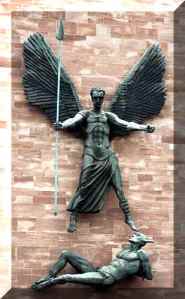
Saint-Michaels-victory-over-the-devil-sir-jacob-epstein, Coventry CathedralIn 1977 I visited the City of Coventry.  This city had had been rebuilt after having suffered severe aerial bombing during World War II.  Many artists had commissions to work in different sections of the new Cathedral.  Sir Jacob Epstein was commissioned to create a work for the new Cathedral’s outside wall.  I marveled at his grand sculpture of Saint Michael the Archangel battling Satan.  The beauty of this monumental sculpture has stayed with me all these thirty years.

The demons depicted in “St. Michael” are primeval; a brute force with heavy thick scales covering them. They emerge from the depths of Saint_Michael_and_the_Dragon - John August Swansonthe unknown spaces with destructive force. They are hidden representing that part of nature that remains with us from our deepest and ancient forms of life. The growth and development of the human race has been to struggle to overcome these forces.

St. Michael, the archangel has an ancient name meaning “who is as God”. References to him are in the Book of Daniel, The Qur’an, the Book of Revelation, the Midrash as well as many other ancient religious texts, traditions and legends. There are shrines and special sites around the world dedicated to St. Michael invoking his assistance and protection.

The archetype or symbolism of the Archangel battling demons has a power that goes deep into our psyche.  It helps us see our own efforts to grow as humans in overcoming ignorance, hatred, violence and despair.  We see our struggles of life as universal and transcending the personal to apply to every human who has had to decide, choose, begin again, and find peace.  This internal struggle connects us to our ancient past, to our ancestors, and the Human Family today.  By our own understanding we can grow in compassion and hope; for others and for ourselves.  As a child, knowing about angels gave me a sense of being loved and helped me through difficult times.  I remember the small holy cards with images of angels watching over children.  I would keep one close to my bed.

Catholic Culture.org

To many, Saint Michael the Archangel, “Captain of the Heavenly Host,” is best known as that dauntless spirit who vanquished his peer among the angels, Lucifer, once called “the Star of the Morning.” Michael is a star of the love than conquers pride. Sometimes he is pictured as a winged angel in white robes, but oftener as the armed warrior on the errands of God, about his head a halo and under his foot the demon, prone and helpless. He was honored in Jewish tradition, and became the champion of Christian warriors as well, although in early ages he was also given the protection of the sick. Of his early sanctuaries, the best known is Monte Gargano in Italy, where he appeared in the fifth or sixth century to the Lombards and insured their victory over the Greek Neapolitans. In the Middle Ages Michael became in Normandy the patron of mariners. His shrines were built in high places, facing the sea, and Mont-Saint-Michel on its rock is the greatest example of devotion to him, a place of pilgrimage a thousand years ago as it still is today.

Mont St. Michel-2In Ireland, Michaelmas was one of the most important feasts of the year, and people prayed especially on this day for protection against sickness. A goose or a sheep or a pig was especially killed and eaten at Michaelmas at a feast of thanksgiving, connected by some with a miracle of Saint Patrick performed with the aid of Michael the Archangel. And the Irish made a Michaelmas Pie into which a ring was placed — its finder was supposed to have an early marriage. In Scotland, Saint Michael’s Bannock was made on his day, as well as a Saint Michael’s Cake, that all guests, together with the family, must eat entirely before the night was over.In Scotland, Saint Michael’s Bannock was made on his day, as well as a Saint Michael’s Cake, that all guests, together with the family, must eat entirely before the night was over.

Gail Ramshaw, Sundays and Seasons
IMAGES IN THE READINGS

In the several centuries before Christ, Judaism had been influenced especially by Zoroastrianism, which speculated about many types of supernatural beings. In Jewish angelology, God had four primary angelic assistants, who, according to some of the pseudepigraphal writings, held up the throne of God: Gabriel, who was to announce the end of the world; Michael, who was the conqueror of Satan and protector of Israel; Raphael, who healed the sick and protected travelers; and Uriel, who punished evildoers. Christian story-telling retained the first three archangels but dropped Uriel. Many medieval artists depicted the archangel Michael as victorious over the monster Satan. Identified with warfare, Michael was popular in Christian imagination.Saint_Michael_University_BonnIn Jewish apocalyptic literature, the origins of evil get backdated before Adam and Eve to a similar story before the human creation: God had created all things good, including the hierarchical ranks of angels. One archangel, Lucifer, which means “bearer of light,” wanted to be like God and so lead a rebellion in heaven against divine authority.

The archangel Michael led the forces of good, and in the battle Satan, which means “the adversary,” was thrown out of heaven and down into the depths. Thus Satan-Lucifer now resides below, in a place identified later as Hades, and still later as hell. This story gives a cosmic background to that of a human couple in a garden. The story of Lucifer’s fall from grace provides one response to the perennial inquiry as to whether God created evil. According to this story, the angels, like humans, have free will, either to obey or to resist the will of God.

Ben Johnson, Editor, Historic-UK.com

Michaelmas, or the Feast of Michael and All Angels, is celebrated on the 29th of September every year. As it falls near the equinox, the day is associated with the beginning of autumn and the shortening of days; in England, it is one of the “quarter days”.There are traditionally four “quarter days” in a year (Lady Day[, or The Annunciation] (25th March), Midsummer[, or St. John the Baptist] (24th June), Michaelmas (29th Spetember) and Christmas (25th December)). They are spaced three months apart, on religious festivals, usually close to the solstices or equinoxes. They were the four dates on which servants were hired, rents due or leases begun. It used to be said that harvest had to be completed by Michaelmas, almost like the marking of the end of the productive season and the beginning of the new cycle of farming. It was the time at which new servants were hired or land was exchanged and debts were paid. This is how it came to be for Michaelmas to be the time for electing magistrates and also the beginning of legal and university terms.St Michael is one of the principal angelic warriors, protector against the dark of the night and the Archangel who fought against Satan and his evil angels. As Michaelmas is the time that the darker nights and colder days begin – the edge into winter – the celebration of Michaelmas is associated with encouraging protection during these dark months.

The Michaelmas Daisy, which flowers late in the growing season between late August and early October, provides colour and warmth to gardens at a time when the majority of flowers are coming to an end. As suggested by the saying below, the daisy is probably associated with this celebration because, as mentioned previously, St Michael is celebrated as a protector from darkness and evil, just as the daisy fights against the advancing gloom of Autumn and Winter.

Michaelmas Daisies, 2

“The Michaelmas Daisies, among dede weeds,
Bloom for St Michael’s valorous deeds.
And seems the last of flowers that stood,

Till the feast of St. Simon and St. Jude.”  (28 Oct.)

Sundays and Seasons, 29 September 2013
(Miriam Therese Winter, SCMM, in Homilies for the Christian People, 567)

Forget the vain pursuit of halo and harp. Enough of those larger than life, militant seraphim who support our propensity for war. Put aside the hierarchical, patriarchal imagery. Angels have something important to teach us about ourselves and God. Angels remind us that our material world is influenced by the world of the spirit, and that we are intrinsically capable of inhabiting both worlds with equal ease. Humanity may rank a little lower than the angels because we are flesh as well as spirit, yet through Jesus who is God’s own Word made flesh, we can rise above the angels to share in the very life of God. Look closely, and you will see that angels reveal God’s secrets, guard and protect the vulnerable, are witness to miracles, are called to unending praise. Today we celebrate not only their achievements, but also that potential in ourselves to be and do the same.

PNJ:  And more…  Thanks be to God!

From the Dean’s Desk…

“Whoever is faithful in a very little is faithful also in much; and whoever is dishonest in a very little is dishonest also in much. If then you have not been faithful with the dishonest wealth, who will entrust to you the true riches? And if you have not been faithful with what belongs to another, who will give you what is your own? No slave can serve two masters; for a slave will either hate the one and love the other, or be devoted to the one and despise the other. You cannot serve God and wealth.”     (Luke 16.10-13)

In Greed We Trust

Oh, Jesus, dear Lord, beloved Master, you sure can be a pain in the… Sorry, what I mean is, you give us such challenging things to consider, don’t you?  Whatever happened to all your lovely Hallmarky Precious Moments?  What on earth are we supposed to do with such ridiculous, uh, sorry, I mean, amazing stories you tell, and the puzzling conclusions you share in these hard sayings which follow?

It seems our Lord Jesus, even in his earthly life, was a very keen observer of human behaviour and of human nature.  He took careful note of how much effort people put into getting rich, and even how carefully they thought about it, how inspired they seemed, in fact.  His parable, his story, is about such a man.  After telling it, Jesus basically asks his disciples if those who are working for treasure which does not endure and cannot satisfy work so hard and are so shrewd, why are they not willing to work at least as hard, why not truly in-spired (filled with the Spirit), why not just as enthusiastic (filled with God), for the most amazing treasure ever?  Don’t be a schmuck (paraphrase, folks, this is a paraphrase); you know what’s at stake:  Citizenship in the Reign of God, partnership with the Creator in building a new creation, and a life which endures forever even while it satisfies now in joyful abundance that the world cannot understand.

What is our truest treasure?  That is also our god.  Is it the one true God, or is it something/someone else?  Just think of the parable Jesus could make of the Wall Street/City ‘shrewdness’ which led to the collapse of 2008 and the Great Recession, still ongoing for millions of people around the world.  Even so, Jesus asks us also, why can’t you be as creative and shrewd as those folks were, not for wrecking, but for building?  What you have to offer is a true treasure, and it won’t hurt anyone.  Actually, what you have to offer will heal and give life, as you follow me, and let me live in you and work through you.

Whom do we serve?  God or wealth?  What defines us?  The love of God, or the love of money/success/celebrity/whatever else that is not God?  Whom do we worship, God or greed?  What is our truest treasure, dear friends?  What is yours?

I have held many things in my hands, and I have lost them all; but whatever I have placed in God’s hands, that I still possess.     (Martin Luther)

What we do with what we have reveals whom we serve.  What we do with our lives reveals the focus of our worship.  Life is worship; may ours reveal that we worship and serve the one true God who is love, living as disciples of our Lord Jesus Christ, in whom the God of love, mercy, compassion, and hope is most clearly revealed to all the world.  For that love, mercy, compassion, and hope, what else can we say?  Thanks be to God!

Yom Kippur – The Great Day of Atonement

Yom Kippur logo


A blessed fast to our Jewish sisters and brothers for the Day of Atonement,
Yom Kippur, which begins this evening at sunset and lasts until sunset tomorrow. Read an overview of this highest, holiest day on the Jewish calendar.

For all who have forgotten, and there are too many, Jesus was a Jew, and this day was, therefore,for him also the highest, holiest day of the year, the only day when the High Priest,and that one alone, would enter the Holy of Holies in the Temple to make sacrifice for the sins of all the people and so atone for that entire year of sin.

This shall be a statute to you for ever: In the seventh month, on the tenth day of the month, you shall deny yourselves, and shall do no work, neither the citizen nor the alien who resides among you. For on this day atonement shall be made for you, to cleanse you; from all your sins you shall be clean before the Lord. It is a sabbath of complete rest to you, and you shall deny yourselves; it is a statute for ever. Leviticus 16:29-31

Yom Kippur, prayer
Baruch atah adonai eloheinu melech ha’olam asher kid’shanu
b’mitzvotav v’tzivanu l’hadlik neir shel (shabbat v’shel) you hakippurim.

From the Dean’s Desk…

The grace of our Lord overflowed for me with the faith and love
that are in Christ Jesus.              I Timothy 1:14

I’ve often thought I’d like this verse on my tombstone.  That’s a decision I haven’t finalized yet, but this verse is such a powerful word of Gospel, of God’s good news in Jesus Christ, that I find it almost irresistible.  God doesn’t do things by halves; no, everything is in full measure, or, better yet, overflowing.  Especially when it comes to grace, that steadfast love – unfathomable mercy and compassion – which is known most clearly in the life, death, and resurrection of Christ Jesus, through the gift of faith.  What a treasure we have, a treasure with power enough to change the world, with power enough to change our lives, and even our life together.  God never, ever gives up on us.  This is wonderful word to hear after the reading we have from Jeremiah for Sunday, which sounds quite ominous at first.

LOST

For my people are foolish, they do not know me;
they are stupid children, they have no understanding.
They are skilled in doing evil, but do not know how to do good…
For thus says the LORD: The whole land shall be a desolation;
yet I will not make a full end.

The prophet does not have an enviable job.  He is called to deliver this message to the people of Judah, who have broken covenant with the LORD, over and over.  God is, to say the least, frustrated.  It’s possible to read this as the action of a divine monster, who watches us, waiting to pounce and punish.  However, in reading the whole of the Scripture through the lens of Cross and Resurrection, I find that this viewpoint becomes virtually impossible.

Even in the words of the Prophet, the Word of the LORD, there is still a promise of hope:  I will not make a full end.  As the ministry of Jeremiah continues, this word of hope is given over and over again (i.e. Jer. 29:11).  Even though the people are suffering what is ultimately the consequence of their own bad choices, their own foolishness and stupidity, in other words, the consequence of their sin, God refuses absolutely to give up on them.

As revolutions and civil wars churn and burn this very day, as people suffer and die, as the earth itself groans from the painful consequences of our greed, yes, our stupidity and foolishness, and the world changes in ever more destructive patterns, all suffer – not so much the punishment of a vengeful God as the inescapable consequences of our sin.  Nevertheless the God who is self-defined as Love, Lost Coin, Found-2will not give up on us.  Wow!  It’s almost incredible, but that which confirms it forever is the witness and the power of the Cross and Resurrection of Jesus the Christ.  Overflowing grace indeed!  Why, one might even dare to call it amazing grace.

It’s exactly this kind of grace, overflowing, amazing, that is at the heart of the three parables told by Jesus in Luke 15, the first two of which are the Gospel for Sunday.  All three stories tell of a love which will not give up, which will not admit defeat, which persists no matter what.  There is a lost sheep, a lost coin, and a lost son (The ‘Prodigal’ Son); none of the seekers gives up, not the shepherd, not the woman, not the waiting father.  All persist, and so all the lost are found, all are safe, and there is great rejoicing.  This is the very heart of God revealed in Christ Jesus, grace so abundant, so amazing, so overflowing, that we can’t possibly contain it, no matter how hard we might be tempted to try.

Jesus welcomes sinners and eats with them.  Yes, exactly, you understand.  We too are invited and welcomed to his meal.  It’s a simple meal, really, just bread and wine by all appearances, but our host is also our food, and in, with, and under his body and blood, we sinners are blessed yet again with his true presence and the grace of our Lord which overflows for us, so that we are forgiven and renewed in the strength of true joy, so that we can then share all of it with others for the healing of creation, the healing of the nations, and for the glory of God.

Thanks be to God! 

Happy New Year (Rosh Hashanah) to our Jewish sisters and brothers!

Rosh Hashanah, L' Shanah Tovah Tikatevu

Shehecheyanu - blessing of praise
Baruch atah Adonai, Eloheinu Melech haolam,
shehechehyanu, v’kiy’manu, v’higianu laz’man hazeh.

Our praise to You, our Eternal G-d, Sovereign of all:
for giving us life, sustaining us, and enabling us to reach this season.

Rosh Hashanah begins at sunset tonight.
Happy New Year to all our Jewish sisters and brothers,
and richest blessings for the High Holy Days ahead,
the Days of Awe, which conclude with the Great Day of Atonement,
Yom Kippur.

Here is a lovely, short video with some helpful commentary.