Shrove Tuesday

this article has been copied from Anglican Online Resources

The day before the beginning of Lent is known as Shrove Tuesday. To shrive someone, in old-fashioned English (he shrives, he shrove, he has shriven OR he shrives, he shrived, he has shrived), is to hear his acknowledgment of his sins, to assure him of God’s forgiveness,and to give him appropriate spiritual advice. The term survives today in ordinary usage in the expression “short shrift”. To give someone short shrift is to pay very little attention to his excuses or problems. The longer expression is, “to give him short shrift and a long rope,” which formerly meant to hang a criminal with a minimum of delay.

On Shrove Tuesday, many Christians make a special point of self-examination, of considering what wrongs they need to repent, and what amendments of life or areas of spiritual growth they especially need to ask God’s help in dealing with.

On Shrove Tuesday, many Christians make a special point of self-examination, of considering what wrongs they need to repent, and what amendments of life or areas of spiritual growth they especially need to ask God’s help in dealing with. Often they consult on these matters with a spiritual counselor, or receive shrift.

Shrove Tuesday is also called Fat Tuesday (in French, Mardi=Tuesday; gras=fat, as in “pate de foie gras”, which is liver paste and very fatty), because on that day a thrifty housewife uses up the fats that she has kept around (the can of bacon drippings, or whatever) for cooking, but that she will not be using during Lent. Since pancakes are a standard way of using up fat, the day is also called Pancake Tuesday. In England, and perhaps elsewhere, the day is celebrated with pancake races. The contestants run a course while holding a griddle and flipping a pancake. Points are awarded for time, for number and height of flips, and number of times the pancake turns over. There are of course penalties for dropping the pancake.

The day (or sometimes a longer period immediately preceding Lent) is also called CARNIVAL, which means “farewell to meat.” “Carni” as in carnivorous, and “vale” as in valediction, valedictorian, etc. One last hamburger before the Lenten fast begins!!

A thrifty housewife uses up the fats that she has kept around for cooking, but that she will not be using during Lent. Since pancakes are a standard way of using up fat, the day is also called Pancake Tuesday.


A New Way of Thinking About Church: Part 2

In this continuing series of notes from talks presented at the Refreshing Winds Conference at Canadian Mennonite University by keynote speaker Brian McLaren, we explore Stage 2 of a four-stage framework for understanding the spiritual life.

McLaren believes that Christians move through different spaces or stages of experiencing and understanding the spiritual life.  In his second talk, McLaren asks us to think of people we may have encountered who might say, “I’m very spiritual”.  They might deny attendance at a church or even say that they are not religious, but they believe themselves to be spiritual.  McLaren suggests that the underlying message of this statement might be that a person doesn’t believe that science, politics or economics has all the answers, but also doesn’t believe that organized religion has all the answers either.

Can our churches actually help people have a direct experience of God? Unless the answer is yes, there’s no reason to come.

McLaren explains if spirituality and religion have the answers, then they are also the problem.  It’s not the organization of the church that is the problem, it’s what the organization does; it forces us into an “us versus them” stance.  Life can’t be reduced to mechanisms, McLaren states, there’s got to be something more to life.  McLaren believes that people are searching for a spirituality that pervades all of our lives – a practice that leads to personal experience.  We are looking for practices that are sacred and, McLaren suggests, people look to experiences such as getting into nature or hanging out with friends as sacred space and time.  This search is ultimately a search for an experience of the Holy Spirit.

Continue reading

The Church in the Post-Christendom Age

The following text is taken from a sermon preached on Sunday, February 6, 2011 by the Rev. Canon Rick Condo, Interim Priest of St. John’s Cathedral.  As an introduction to the parish’s discernment process, which was begun at the first congregational gathering after the service that morning, the sermon provided a broader context of what is happening in mainline Christianity.  It is intended as a kind of backdrop for the parish as it moves through this time of transition.

The Age of Christendom is over

The Age of Christendom (a term which blends the words ‘Christ’ and ‘Dominion’) is over.  No longer is Christianity the one dominant religion in North America.  The once powerful religious influence of the Church in matters of rule, governance, and establishment has ended.  How did this happen?  To answer this question, we need to look briefly at the ages through which Christianity has traveled since the death, resurrection and ascension of Jesus Christ.

The Apostolic Age

During the first three centuries A.D., the Christian Church was in its infancy.  The world outside the church (especially the ruling powers of Rome) was considered hostile towards the faith.  Christians were being persecuted, arrested, incarcerated, and oftentimes executed.  The Church therefore needed to be careful about who was let in.  Only those who bought into the Christian purpose and mission were allowed to be baptized.  A three-year period of intense baptism preparation enabled the Church to screen out any who were not willing to engage in a serious change of life-style that would lead to their Christian initiation.

During this age of the Christian Church, the apostolic task of witness to the faith derived from an understanding of the church’s mission as being right outside its doors (not in some far off country).  Local church leadership was not hierarchical, but rather functional.  There was very little difference between clergy and laity.

So, despite the growth taking place in Christianity during the Apostolic Age, the Church was not “in the driver’s seat” in the affairs of the wider community within which it was struggling to stay alive.

The Christendom Age

Christianity went from the margins of Roman society to its centre,  from being legally banned to being legally mandated.

In the early part of the 4th century A.D., the Roman emperor Constantine I embraced Christianity.  Following his conversion experience in 312 A.D., Constantine declared the Christian faith to be the official religion of the Roman Empire (hence the term “Holy Roman Empire”).  Church and state were amalgamated.   Christianity went from the margins of Roman society to its centre,  from being legally banned to being legally mandated.  Public institutions were required to teach Christian morals.  Within the Roman Empire, one was born into the Christian faith and Church.   Therefore, it was illogical and illegal to not be Christian.

Within the organization of the Church, ministry became professionalized (the property of the ordained) and hierarchical.  The clergy’s task was to look after the religious needs of parishioners, while the role of the parishioners was to support their parish church and clergy, and the hierarchy of the state church.

The Church’s mission was no longer regarded as right outside its doors, since all of society was “Christian.”  Instead, mission was overseas  –  somewhere else  –  as Roman armies endeavoured to conquer new lands and people for Christ.

The Church institutionally came to be identified with culture.   Society and faith overlapped;  being a good Christian and being a good citizen were equivalent. Christendom was in large measure responsible for the building of colleges & universities, the establishment of hospitals and welfare institutions, developments in the arts, and exercising great influence over governments and the economy.

In North America, church and culture were interwoven. Canada and the United States were regarded as Christian nations.

In North America, church and culture were interwoven.  Canada and the United States were regarded as Christian nations.  Public holidays were observed around Christian festivals (e.g., Christmas, Good Friday, Easter Monday).  School days began not only with the singing of the national anthem, but were accompanied by the Lord’s Prayer and some scripture reading.  The truth of testimony given in a court of law was authenticated by the witness placing his/her hand on the Bible.

The Post-Christendom (Emerging) Age

The Christian Church’s position as organized and influential religious belief has given way to a greater variety of autonomous and individual choices in spirituality.

Early in the 20th Century, a great surge of immigrants from other countries brought people of different cultures and religions to North America.   As a result, society became culturally and religiously pluralistic.  Canada was no longer a Christian nation.  With the emergence of an officially secular society, the Church began to witness the disestablishment of mainline Christianity.

The Christian Church’s position as organized and influential religious belief has given way to a greater variety of autonomous and individual choices in spirituality.  There has been a steady exodus of people out of traditional churches  –  some into more fundamentalist “big box” churches, others into many of the community and sporting activities that had previously been banned from Sundays under the Lord’s Day Act.

Now, the Church’s mission has drawn back from strictly overseas work, and has returned to the local congregational neighbourhood.  Unlike earlier times, however, the world outside the Church (at, least in North America) is rarely hostile, but more often indifferent.  Within many parishes, the ministry of the baptized has become pivotal, with the clergy being called to ‘support’, not to ‘do’ ministry.  Faith is now chosen, not inherited, such that many of those who attend church do so out of personal decision and conviction, not family coercion.

Now, the purpose of the Church is to change lives

During the Christendom Age, the purpose of Church had been to act as the conscience of the community, to aid the less fortunate, and to be the centre of family and community life.  Now, in the Post- Christendom Age, the purpose of the Church is closer to that of the Apostolic Age (i.e., to change lives).  This means that local congregations are choosing to set as their mission or purpose the work of growing people of faith, of being and making disciples of Jesus Christ for the sake of the world.

Mission and ministry are no longer the exclusive property of the ordained; they now belong to the whole community of faith.

In order to engage in this primary task, the Church itself must become “missional” in its life and ministry  –  called to be an instrument of God’s mission of healing God’s creation.  Mission and ministry are no longer the exclusive property of the ordained; they now belong to the whole community of faith.  Clergy are, therefore, no longer simply “deliverers”, but rather “developers” of ministry  –  equippers, enablers and mentors of the baptized.

As this parish moves through a time of discernment, it is imperative that we be continually aware of what the Spirit of God is saying to us.  Through our prayers and discussions, may we seek the mind of Christ in the decisions that are to be made concerning the mission and ministry of this parish, and the kind of leadership gifts that will be required of a new Incumbent of the parish and Dean of the diocese.

A New Way of Thinking About Church: Part 1

Introduction

I recently had an opportunity to attend the Refreshing Winds Conference at Canadian Mennonite University.  The keynote speaker for the event was Brian McLaren.  I had heard Brian McLaren speak at Lambeth Conference in August, 2008.  I thought he had some interesting things to say then, so I was looking forward to hearing him again.

McLaren offers new Biblical models for how we understand the central ideas of faith that provides hope for restoring and reinvigorating the power of the gospels to transform us and our communities.

Brian McLaren has written several books, among them is A New Kind of Christianity, 2001; A Generous Orthodoxy, 2004; and a new book is due out this year, Naked Spirituality.  McLaren offers new Biblical models for how we understand the central ideas of faith that provides hope for restoring and reinvigorating the power of the gospels to transform us and our communities.  McLaren says, “The lack of a simple, doable, durable spirituality undermines the very transformation God is calling us to undergo.  As a result, our religious structures become tools to maintain the status quo and not catalysts for personal and social change”.

Faith in Four Stages

McLaren presented a four-stage framework for understanding the spiritual life.

In his talks at Refreshing Winds, McLaren presented a four-stage framework for understanding the spiritual life.  His message encourages us to “stay true to Jesus’ core message while engaging faithfully with our post-modern world”.

The message about understanding faith in four stages or spaces began with the visual images of sea anemones produced by a diver at 88 ft depth.   The diver had taken a picture at that depth which produced a faint greenish glow.   The diver then turned a full spectrum light on the scene and took another photograph which revealed a hauntingly beautiful scene, rich with colour.  McLaren explained that what you see depends largely on where you are – on the available light.  As you ascend towards the surface, the light increases and more of the beauty can be seen.   Jesus, he explains, desires to bring us to full spectrum light.

Continue reading

Forward Day by Day

The February – April issue of the daily devotional booklet, Forward Day by Day, is now available on the literature rack in the tower entrance. You are welcome to pick up a copy of either the regular or the large print edition.

Have you ever wondered how Forward Day by Day began? Read How a Weary and Divided Episcopal Church Gets Reinvigorated, and moves forward with only twenty people, no budget, and no clear direction to “reinvigorate the life of the Episcopal Church.”

members were asked to pray hard for a month

Here’s an excerpt: Bishop Hobson commented that the Commission faced “probably the vaguest and most inclusive task imaginable.” Commission members returned from General Convention and for several weeks wrote and telephoned one another and asked acquaintances back home how they would reinvigorate the life of the church. Hobson also asked Commission members to “pray hard for a month.”

All day and late into the night commission members talked—and talked and talked, seemingly unable to move beyond bemoaning the problems facing the church. Bishop Hobson asked whether anyone had a plan to propose. No one did. Finally, Hobson mentioned a little essay written by Gilbert P. Symons, a clergyman on Hobson’s staff in Southern Ohio. Hobson asked Symons to read his essay aloud to the commission.

reinvigorating the life of the church would become possible only when church members began to take their discipleship seriously—not generally or vaguely, but in specific ways.

It said that reinvigorating the life of the church would become possible only when church members began to take their discipleship seriously—not generally or vaguely, but in specific ways. Symons discussed discipleship under seven steps: Turn, Follow, Learn, Pray, Serve, Worship, Share. A long silence followed the reading. Bishop Hobson then told the commission members to return to their rooms, pray during the night, and come back in the morning.

After an early communion service and breakfast the next day, the atmosphere had changed. The commission seemed drawn together and quickly hammered out a four-fold plan to reinvigorate the life of the church…

Weekly Readings

Next Sunday’s Readings Online

A list of the readings for the following Sunday are available with links to each passage. To get next Sunday’s readings, got to the right column of this website under “Next Sunday” and click “readings”.

Bible Study and Discussion

Fridays at St. John’s Cathedral
at 10:00 am to noon, September to May
Open to anyone to join us!

Using the lectionary for the forthcoming Sunday (Old Testament reading, Psalm, Epistle and Gospel), we look at the readings in the context of when and why they were written, and how the scriptures relate to people in today’s world. Every Bible Study session is a mixture of learning and laughter, discussion (we may not always agree with each other) and dissertation. We are never at a loss for subjects for discussion and debate of a lively (but friendly!) nature. We invite others to join us for these enjoyable and educational sessions.

Next Sunday’s Readings

Five Steps for Personal Discernment

At certain points in our lives we may be faced with difficult decisions or dilemmas.  As Christians we want God to guide our lives during these times of reflection or re-direction.  Indeed, we have been taught to expect to be guided by the Holy Spirit (Romans 8:14). These expectations of guidance place emphasis upon religious experience and an abiding interaction with God that engages our senses, our choices, our understanding, our prayer and the collective way in which a Christian community engages with the gospel.

Yet rarely do I hear fellow Anglicans pronounce that they have approached their Christian community to engage in a process of discernment or reach a decision about an important life issue. This seems to be an area where we have lost our ability to provide guidance as the gathered Christian community. So how do we engage with our faith and our collective understanding of the gospel in moving forward with what we believe to be God’s will or direction for some aspect of our lives?

Continue reading

Bible Study on The Gospel of Matthew

“Matthew for Everyone” might be for you!

Matthew for EveryoneMatthew for Everyone

Bible Study on “The Gospel of Matthew”
using the two book series by Tom Wright
entitled “Matthew for Everyone”

Mondays at St. Anne’s Anglican Church
starting Monday, January 24 at 7 p.m.
Cost of the two book series is $20.

“Tom Wright’s eye-opening comments on the Gospel of Matthew and what it might mean for us are combined, passage-by-passage, with his fresh translation of the Bible text. Making use of his true scholar’s understanding, yet writing in an approachable and anecdotal style, Wright captures the urgency and excitement of Matthew’s Gospel in a way few writers have.

Christmas Play

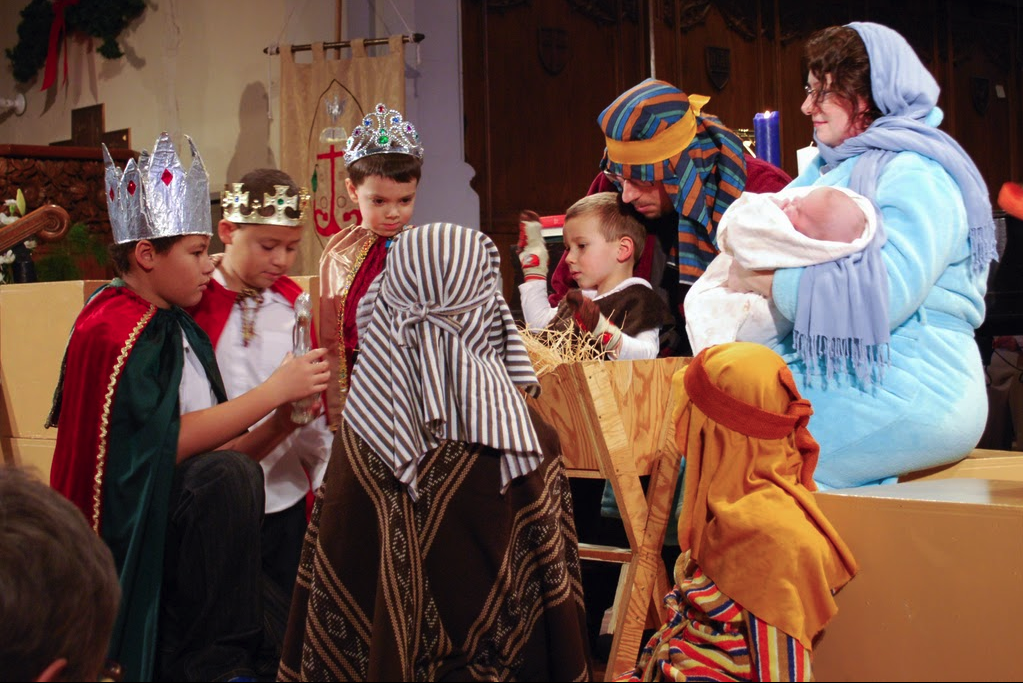
We were pleased to watch the retelling of the Christmas Story this past Sunday. It was wonderful.

Thank you to our Sunday School children, their leaders and to Ryan and Heather Blackman with their new baby, who were this year’s Mary, Joseph and baby Jesus. Great job everyone!